fashion · 1925–1939 · also: Jazz Age jewellery, Moderne jewellery, Tutti Frutti jewellery
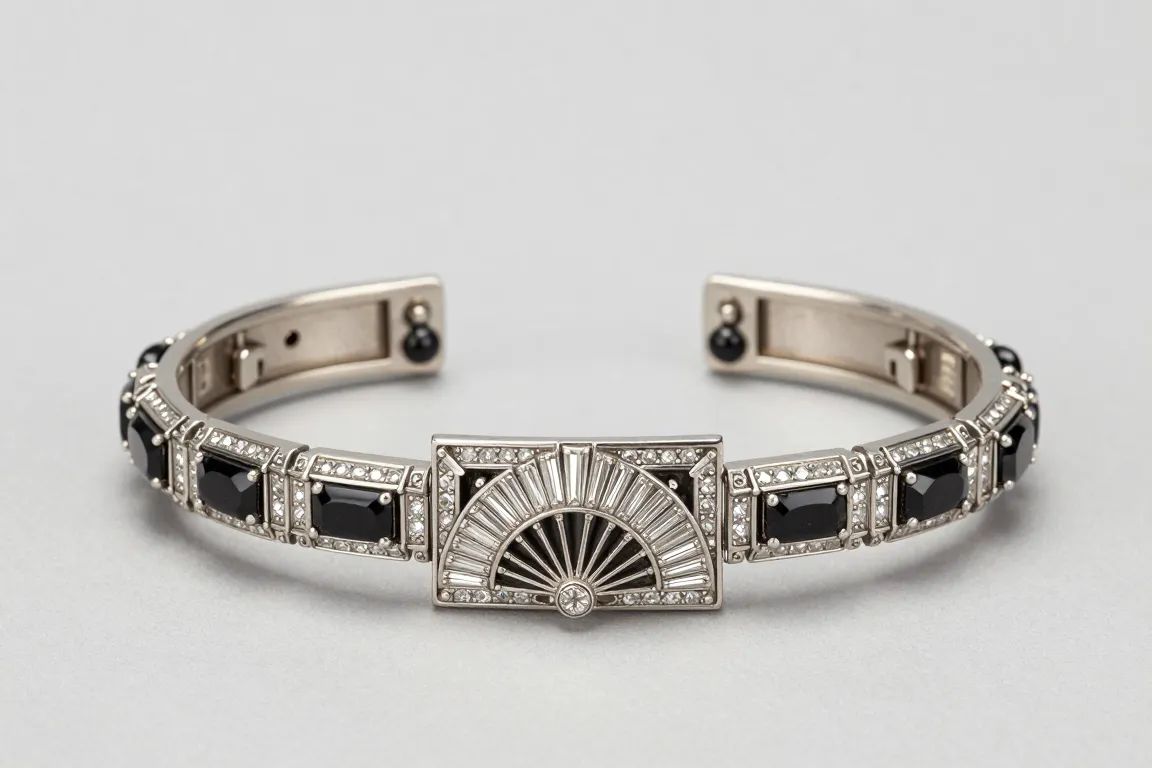
Hard, bright geometry in platinum. The stones are diamonds in baguette and square cuts, black onyx, rock crystal and carved coloured stones, set in strips, fans and sunbursts. It was shown at Paris in 1925.
Core thesis
A jewel is a machine-age design: a hard, flat pattern of line, angle and contrast in white metal and stones.
Design principles
Build the design from straight lines, circles and angles, in a symmetrical pattern.
Contrast white and black: diamonds and platinum beside black onyx or black enamel.
Cut stones in sharp shapes: baguette, square, triangle and calibre, and set them flat in rows.
Use platinum or white gold for the frame, with the claws hidden and the lines as thin as a thread.
Add one strong colour in a carved stone: emerald, ruby or sapphire carved as a leaf, a fruit or a flower (the Tutti Frutti style).
Take forms from the machine, from Egypt, from India and from Cubism: a fan, a sunburst, a stepped skyline.
Make the piece as a strip, a clip or a bracelet that moves, with a flat front and a hinge.
Set stones with no visible metal, in the mystery setting, so that the stones look like one surface.