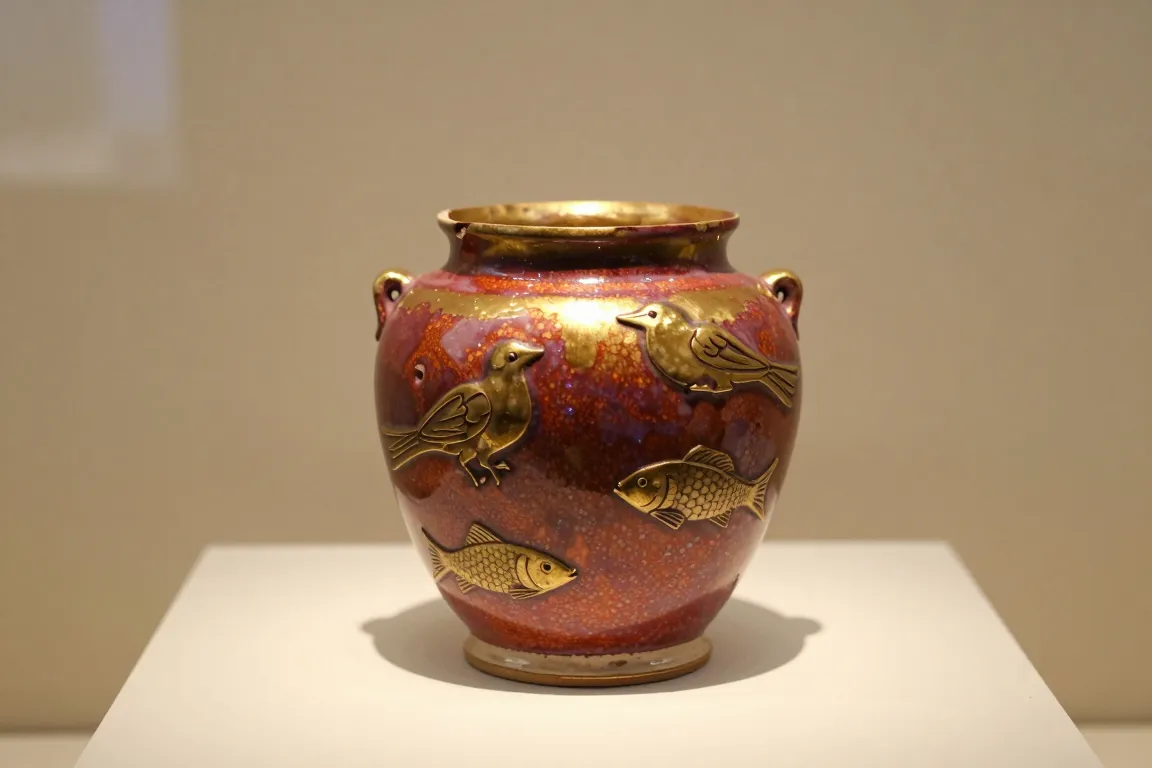
ceramics · 1872–1920 · also: British art pottery, Lambeth art pottery, De Morgan lustreware
Hand-made British art pottery after 1872. The potters of Lambeth, Chelsea and Fulham used salt glaze and ruby lustre, and made each piece one by one with a visible hand.
Core thesis
A pot is a work of art when one person makes it from clay and glaze, and the hand is allowed to show.
Design principles
Make each piece by hand, with the maker's mark or initials incised in the base.
Throw or build the form with small irregularities of 1 to 3 mm; do not hide the throwing rings.
Fire a salt glaze at about 1200 °C and let it run to an orange-peel surface.
Fire a ruby or gold lustre in reduction at about 600 to 800 °C, so that the copper and silver show as a film.
Paint or incise plants, birds, fish and fantastic creatures, in a free line after Persian and Iznik models.
Use a limited palette of 3 or 4 colours: blue, turquoise, brown and ruby.
Keep the form plain and the surface rich.
Place the pot at home as a decorative object, not as a service.