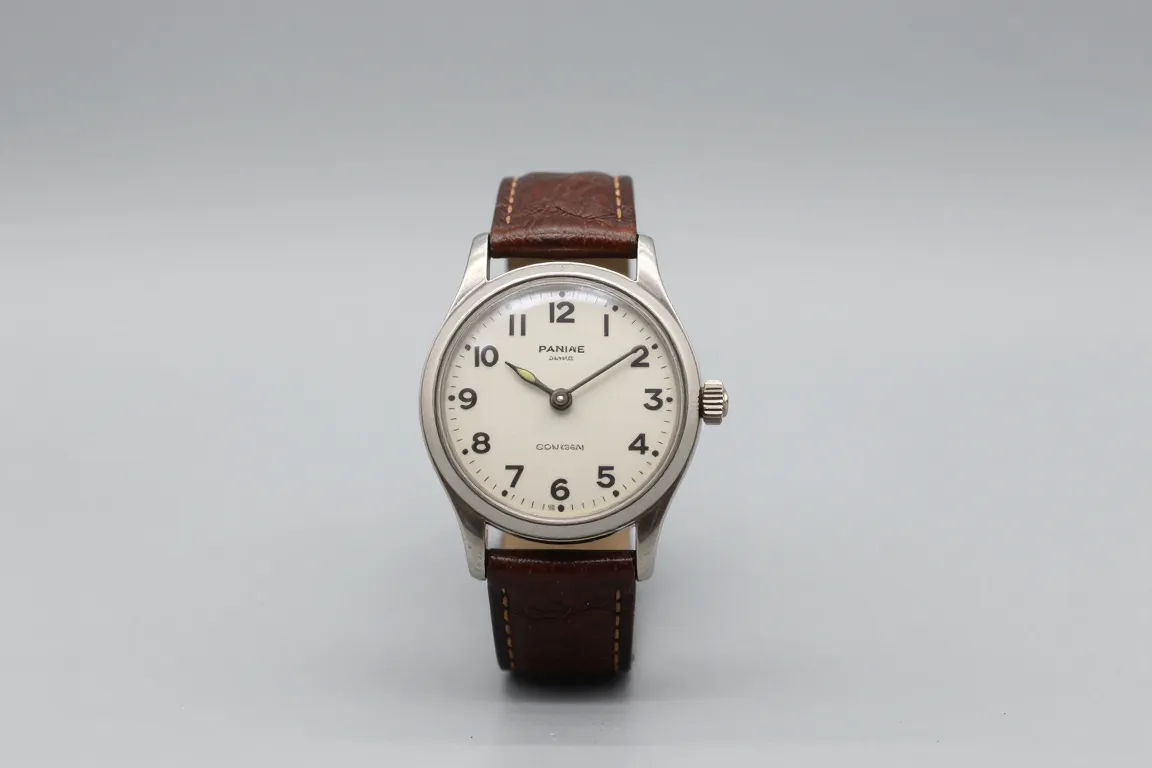
The small watch on a leather strap that replaced the pocket watch between 1904 and the 1920s. It has a 28 to 35 mm case with wire lugs, a white enamel dial and luminous numerals. The trench version has a wire guard over the glass.
Core thesis
Time must be on the wrist, where a pilot, a soldier or a driver can read it with one glance and no free hand.
Design principles
Make the case 28 to 35 mm wide, so that it fits under a cuff and on a thin wrist.
Fix the strap to the case with wire or fixed lugs, so that the strap does not slip.
Print large Arabic numerals on a white enamel dial for a quick read on a moving wrist.
Paint the numerals and hands with luminous paint, so that the dial shows in the dark.
Cover the glass of a field model with a wire guard that turns a blow.
Seal the case with a screw back and a screw bezel, so that sweat and dust stay out.
Fit a small movement, 25 to 29 mm wide and not more than 8 mm thick.
Cut a long, narrow strap of calf leather with a plain pin buckle.