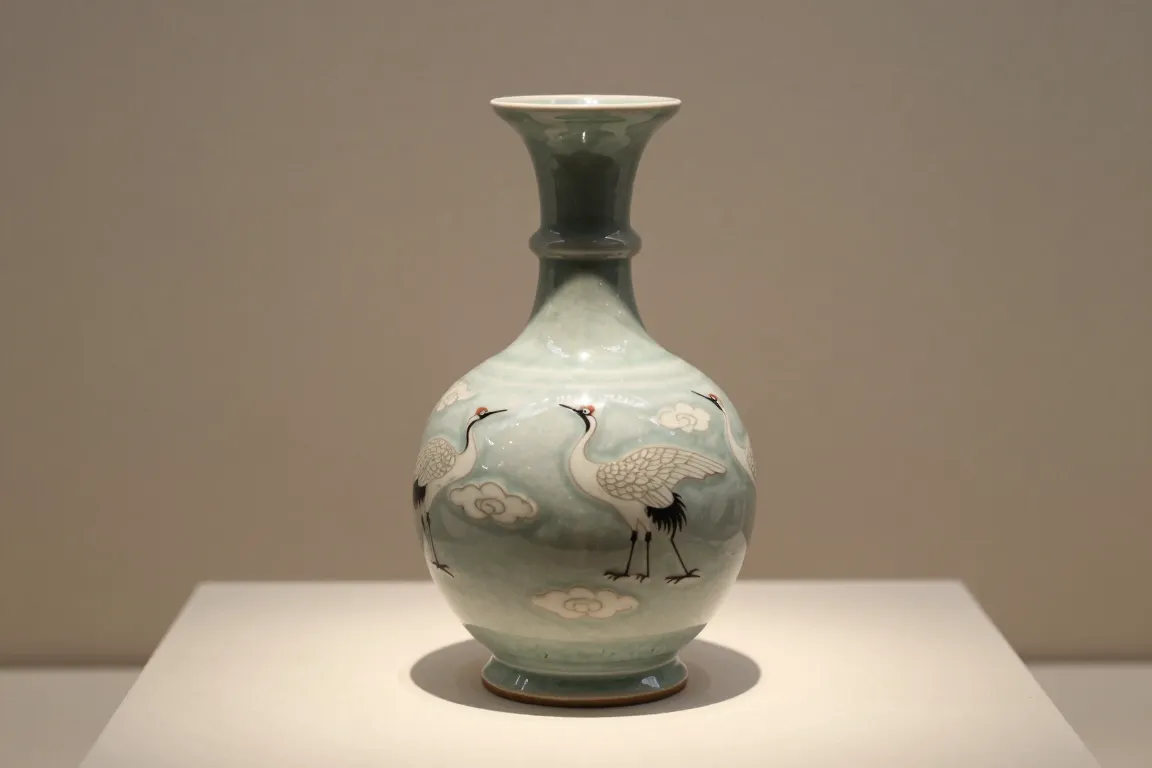
Korean celadon of the Goryeo kingdom. A thin, clear grey-green glaze covers a fine body, and potters inlay white and black slip into incised lines to make a pattern under the glaze.
Core thesis
A pot is a clear green lens over a drawing: the glaze is almost transparent and the inlaid slip line shows through it like ink in water.
Design principles
Fire a fine grey stoneware to a thin, translucent glaze of green-blue, about 0.3 to 0.5 mm thick.
Cut the pattern into the leather-hard clay with a fine tool.
Fill the cuts with white slip and black slip, then scrape the surface clean (sanggam inlay).
Use cranes, clouds, willows, chrysanthemums and lotus as the main motifs.
Shape the body as a graceful maebyeong with a high shoulder, or a gourd-shaped ewer.
Mould a lid or a spout as a lion, a duck or a turtle-dragon, for the finest pieces.
Fire at 1200 to 1250 °C in reduction on small clay spurs.
Anti-patterns
A thick opaque glaze that hides the inlay
Pattern painted on the glaze surface
A brown or yellow glaze from weak reduction
A heavy, thick-walled form with no curve
Plain geometric borders that replace the natural motifs