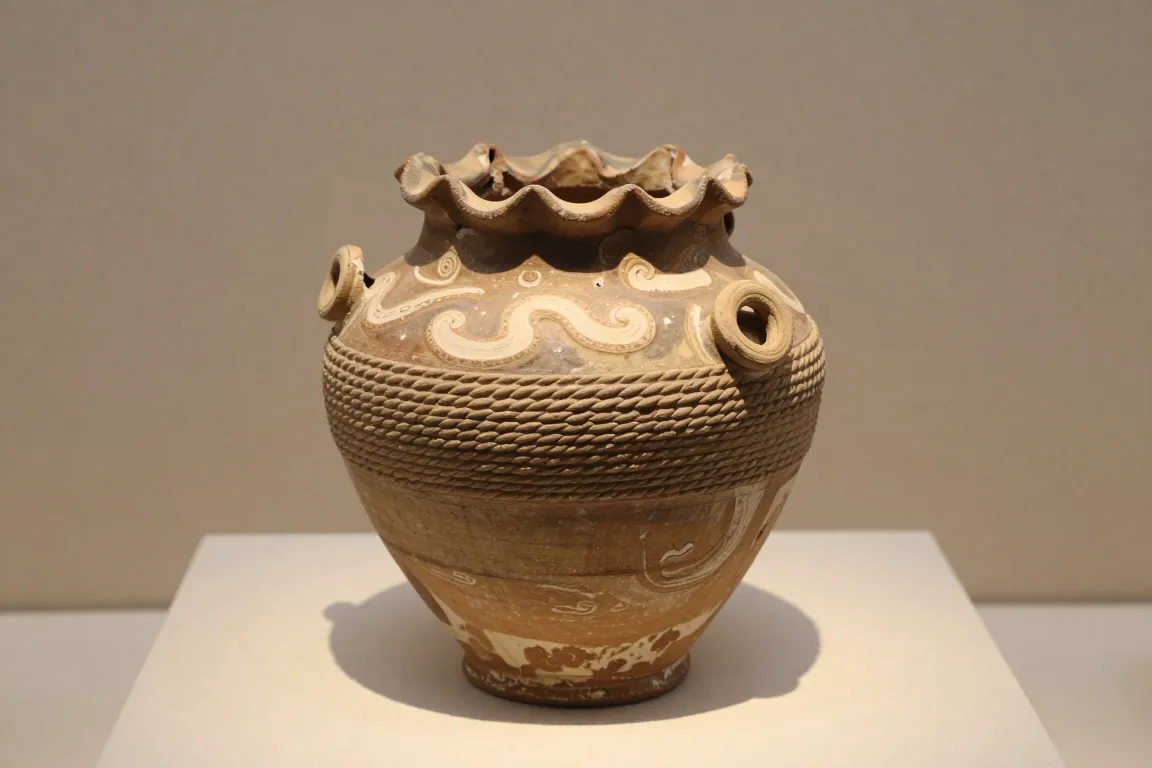
ceramics · c. 14000–300 BC · also: Jomon ware, Cord-marked pottery, Flame-style pottery
The oldest pottery of Japan. Hunter-gatherers coiled a coarse clay into deep pots, pressed twisted cord into the wet wall, and fired the pots in an open bonfire.
Core thesis
A pot is a coiled and fired form that carries the marks of its making: the cord, the cut and the clay itself are the ornament.
Design principles
Build the pot from clay coils 15 to 25 mm thick and smooth only the inside.
Roll twisted cord across the wet outer wall to leave a dense, even texture.
Keep the pot deep: the height is one to two times the mouth width.
Fire the pot in an open bonfire at 600 to 900 °C, with no kiln and no glaze.
Raise the rim of a ceremonial pot into a crown of clay loops, handles and spikes.
Divide the surface into bands: cord-marked, incised, and plain zones that alternate.
Leave the clay body in its fired colour, from buff to dark brown, with black fire clouds.