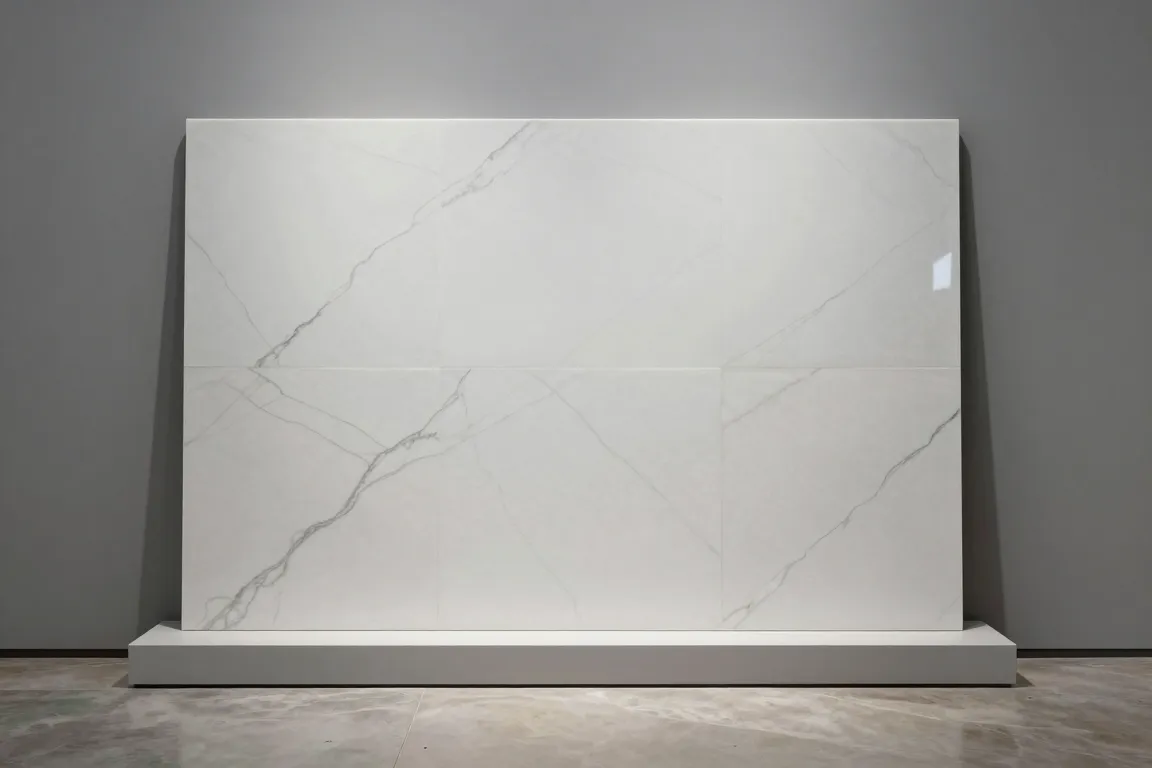
ceramics · 1980–present · also: Porcelain stoneware slabs, Large porcelain slabs, Gres porcellanato, Sintered stone slabs
Very hard, dense tiles that a factory presses in sizes of 60 by 60 cm and above, up to slabs of 3 m. A digital printer gives the surface the look of stone, wood or concrete. Fine joints make the wall or floor read as one skin.
Core thesis
One large, dense, thin sheet of ceramic makes a seamless surface that holds the look of another material.
Design principles
Press the tile to 60 by 60 cm or more, and up to 120 by 280 cm or 160 by 320 cm for a slab.
Fire the body to less than 0.5 per cent water absorption, so that it takes frost, stain and wear.
Keep the tile thin, 6 to 12 mm, for a wall, and 20 mm for an outdoor floor.
Print the surface by inkjet with a design from stone, wood, concrete or metal, and vary the image over many slabs.
Rectify the edges and set the joints to 1 to 2 mm, so that the surface reads as one sheet.
Choose a matt or satin surface of 5 to 30 GU, and add a texture that follows the print.
Use the slab for floors, walls, worktops and facades in one material, with no change at the corner.
Plan the cut and the layout in advance, because a slab has a high cost of break.
Anti-patterns
A small tile with a wide joint and a hand-made edge
A glossy mirror-like glaze that shows each footprint