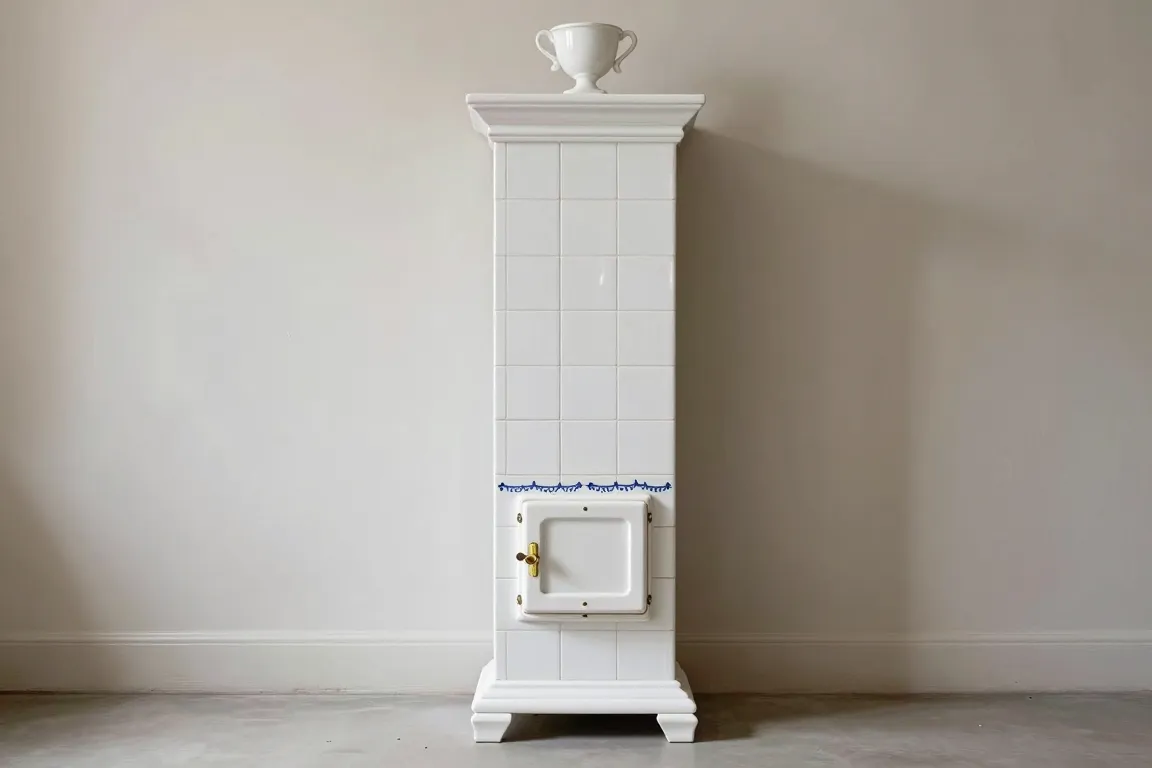
A tall stove clad in white glazed tiles that stores the heat of a short wood fire in a room. The Swedish kakelugn has thin tiles, a plain white face and a soft frame of mouldings.
Core thesis
A white tiled stove is both a machine for heat and a piece of furniture: the glaze reflects the light of a dark northern room.
Design principles
Clad a brick core with flat glazed tiles about 20 cm by 25 cm, and 15 to 20 mm thick.
Make the stove tall and slim, 2 to 3 m high, so that it fits the corner of a room.
Glaze the tiles in a plain white; add a few lines of blue or grey painting for decoration.
Finish the top with a cornice, a crown or an urn, and the base with a plinth.
Cut the flue in long windings of 5 to 8 m, so that the brick stores the heat of the fire.
Use a small iron door and a damper of brass, and keep the metal parts in a simple form.
Mould the cornice and the frames in the same clay, so that the tiles and the mouldings match.
Repeat the neoclassical motifs, the garland, the urn and the fluted column, in low relief.