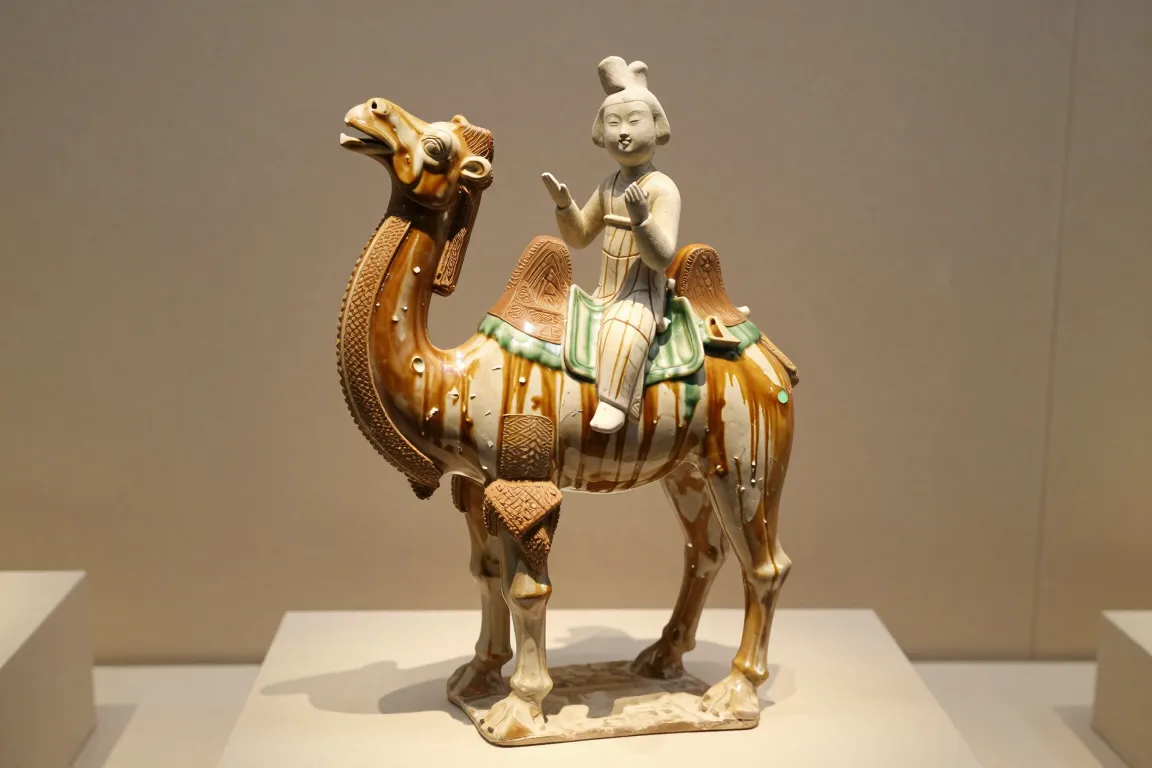
Tomb figures of white earthenware under lead glazes in amber, green and cream that run into each other. Court ladies, Sogdian grooms, camels, horses and guardians show the life of the Silk Road.
Core thesis
A tomb figure shows the luxury of the living court in clay, and a lead glaze in three colours makes the animal or the lady glow.
Design principles
Make the figure from a white or buff earthenware that is pressed in moulds, in parts.
Fire the body once to about 1050 °C before any glaze touches it.
Splash amber, green and cream lead glazes on the biscuit, and let them run and mix in the second firing at 800 to 900 °C.
Leave the face, the hands and sometimes the hair free of glaze, and paint them cold after the firing.
Give a horse a strong neck, a small head and a tied tail, and a camel a raised head that is open to call.
Model Sogdian grooms and musicians with beards, high caps and wide eyes, as the traders of the Silk Road.
Give a guardian a fierce face, a raised fist and a rock base, and a height of 70 to 100 cm.
Keep the glaze off the base, which stays bare and dry, so that it does not stick to the kiln.
Anti-patterns
A single flat colour of glaze over the whole figure
A translucent white porcelain body with thin walls
Neat printed or evenly painted glaze patterns
A small cute figure with a round child-like face
A blue cobalt glaze in the main area
A rough brown unglazed terracotta, like a soldier of Qin