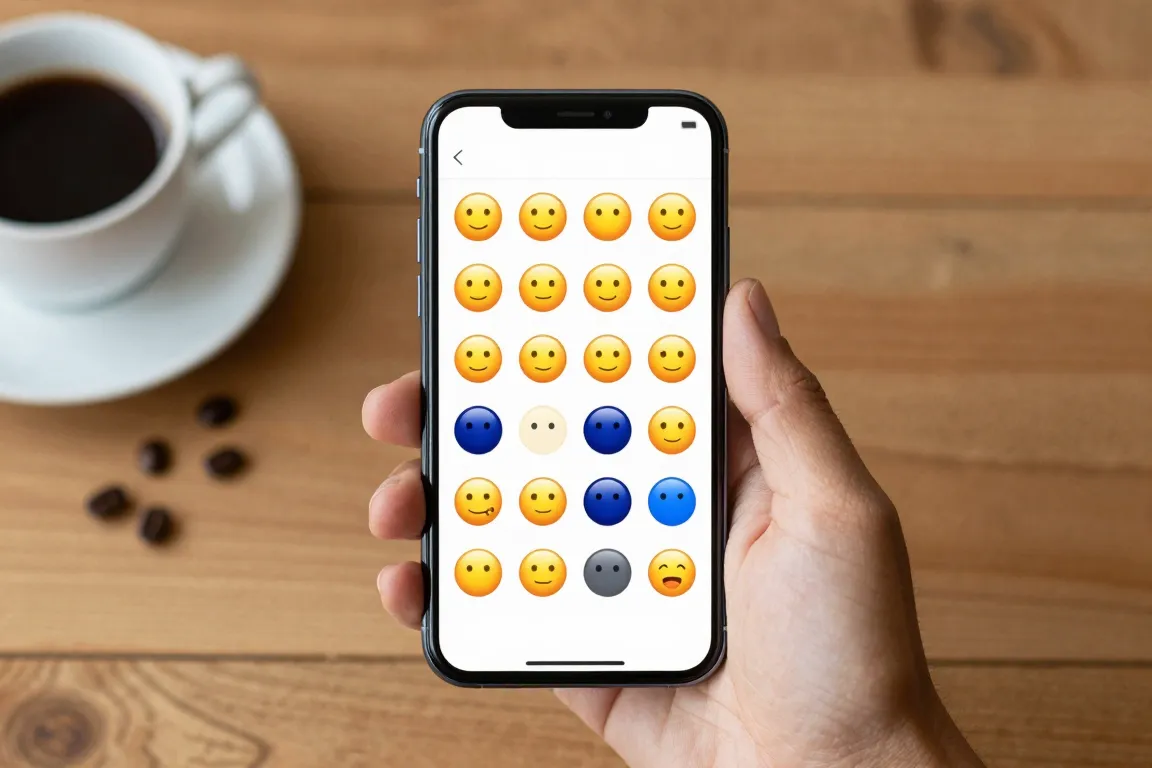
A set of small colour pictures that sit in text as characters: yellow faces, hands, food and flags. Japanese phone makers drew the first sets; Unicode 6.0 added them to the standard in 2010.
Core thesis
A picture becomes a character: the same small yellow face can enter any text on any device.
Design principles
Draw each glyph on a square field with a 1:1 ratio and set it at the line height of the text, 1.2em.
Use a round yellow face (#FFC83D) with a 1px darker rim, two simple eyes and a mouth of one curve.
Fill shapes with flat colour and one soft highlight; keep the outline to 1px or none.
Show a skin tone with 5 swatches from #FADCBC to #3D2B1F as a modifier row under a hand glyph.
Set the glyph in a picker grid of 8 columns with 8px gutters and a tab row of 9 categories.
Keep the text font neutral and round, so that the glyph is the only colour in the line.
Let the glyph be 1.0em to 1.2em in text, and 32px to 48px in a picker.
Anti-patterns
Glyphs drawn at a different size from the line
Photographic emoji with realistic skin and lighting
Heavy outlines of 3px or more
Emoji set on a dark gradient that hides the yellow
Custom emoji with no shared base shape
Mixed glyph sets from different vendors in one line