Victorian boot
fashion · 1851–1914 · also: Button boot, Elastic-sided boot, Balmoral boot
The ankle boot of Victorian dress. It has a kid or cloth upper, a row of buttons or a lace front, an elastic side gusset, and a small stacked heel.
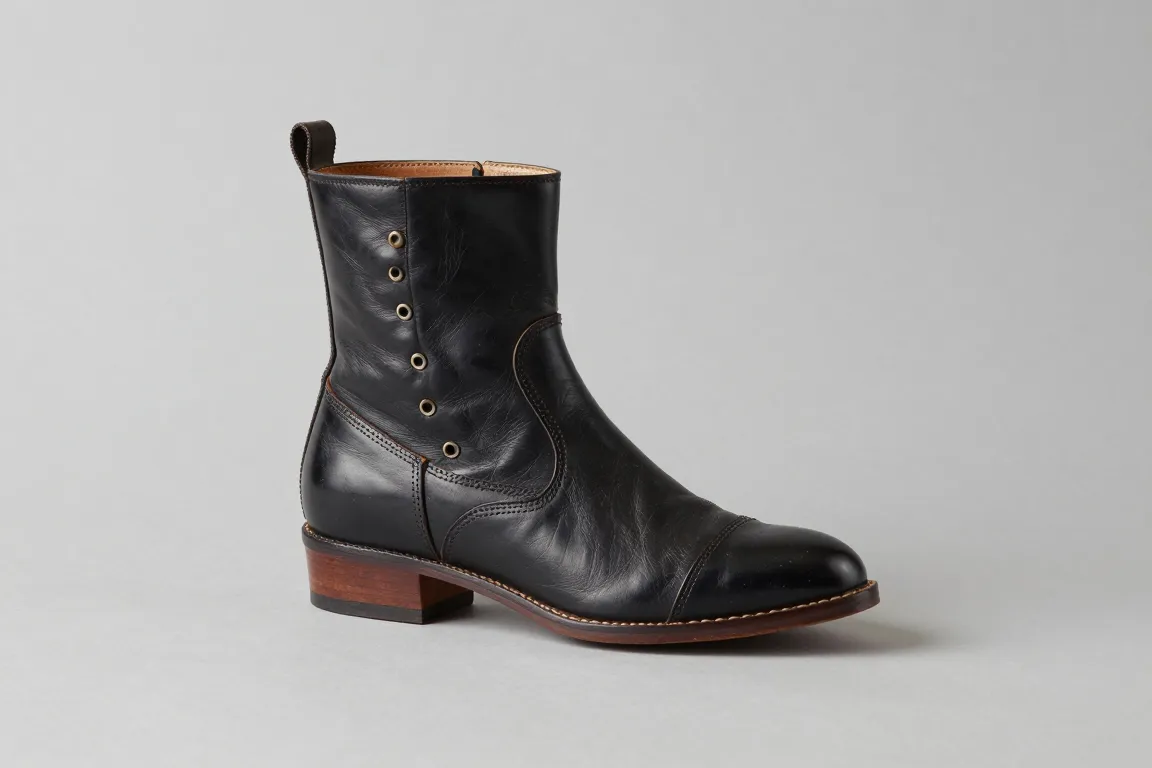
Core thesis
A Victorian woman covers the ankle, so the boot is the shoe of every day and the cloth upper shows the cut of the last.
Design principles
- Cover the ankle: raise the shaft 12 to 20 cm above the heel.
- Close the shaft with 8 to 14 small buttons, or with a lace front of 8 to 10 eyelets.
- Set a 2 to 4 cm stacked heel under the waist of the sole.
- Cut a narrow, slightly pointed toe on a last made for a left and a right foot.
- Add a toe cap of patent leather or kid in a second colour for day wear.
- Insert an elastic gusset of vulcanised rubber webbing in each side for a slip-on boot.
- Stitch the sole to the upper by welt or by pegs; do not glue it.
Anti-patterns
- A bare ankle in town dress
- A flat, round-toed shoe with a single strap
- A heel taller than 5 cm on a day boot
- Rubber and foam soles on a dress boot
- Visible plastic buttons or zips
Palette
Lineage
- Evolved into
- Art Deco dance shoe, English welted dress shoe
Use it
SKILL.md · tokens.css · source JSON · open in the demo