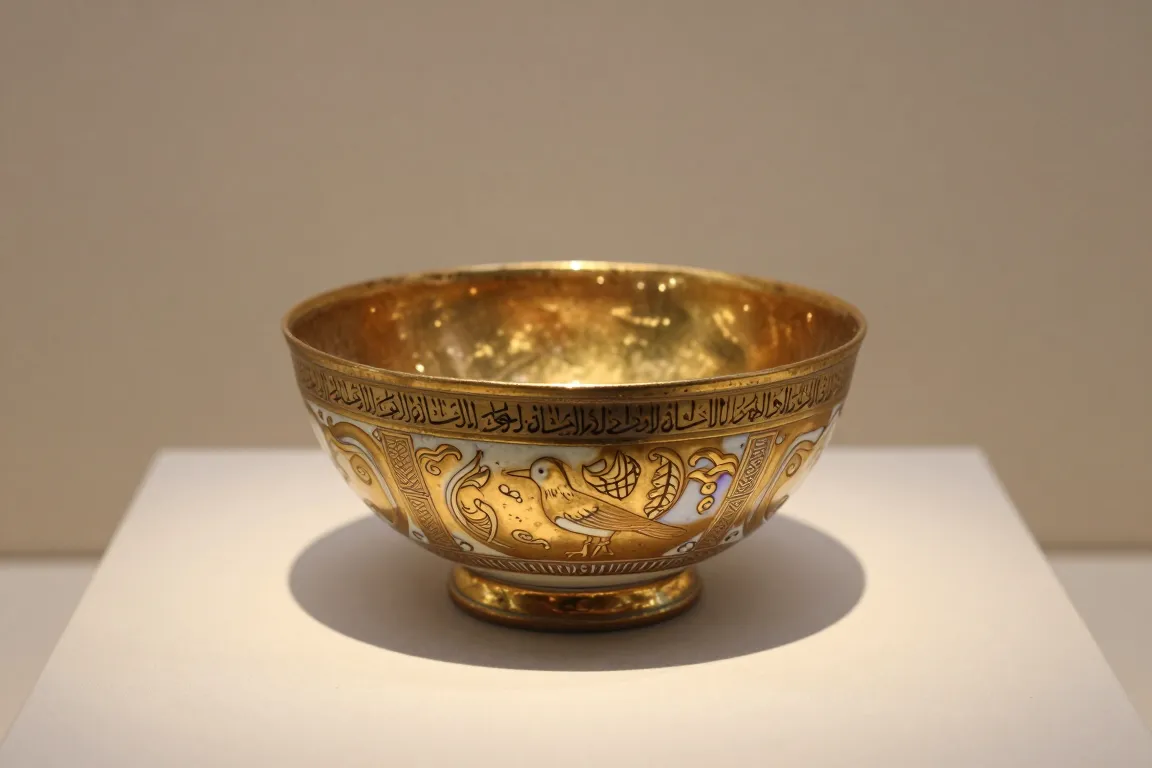
ceramics · 800–1050 · also: Early Islamic lustre, Basra lustre, Lustre-painted Abbasid ware
The first pottery with a metallic sheen. Potters in Abbasid Iraq painted copper and silver oxides over an opaque white tin glaze and fired them in smoke to a gold-brown shine.
Core thesis
A cheap clay pot can shine like metal when a white tin glaze and a thin film of reduced silver and copper turn into a mirror of gold.
Design principles
Cover the earthenware body with an opaque white tin glaze 0.5 to 1 mm thick.
Fire the glaze first, then paint metal oxides in vinegar or ochre over it.
Fire a second time at 600 to 700 °C in a smoky, reducing kiln, so that the metal film forms.
Polish the cooled surface to remove the red clay residue and show the gold-brown shine.
Fill the surface with geometric bands, birds, vegetal scrolls and Kufic-like script.
Leave dark ground with light motifs, or the reverse, in two clear tones.
Keep the shape simple: a flared bowl on a low foot ring, so the sheen catches the light.
Anti-patterns
A flat matt surface with no metallic reflection
Cobalt blue or a coloured glaze under the lustre in large amounts
Figurative scenes drawn with realistic perspective
A thick coarse wall with no clear foot
Gold leaf or applied gilding instead of true lustre