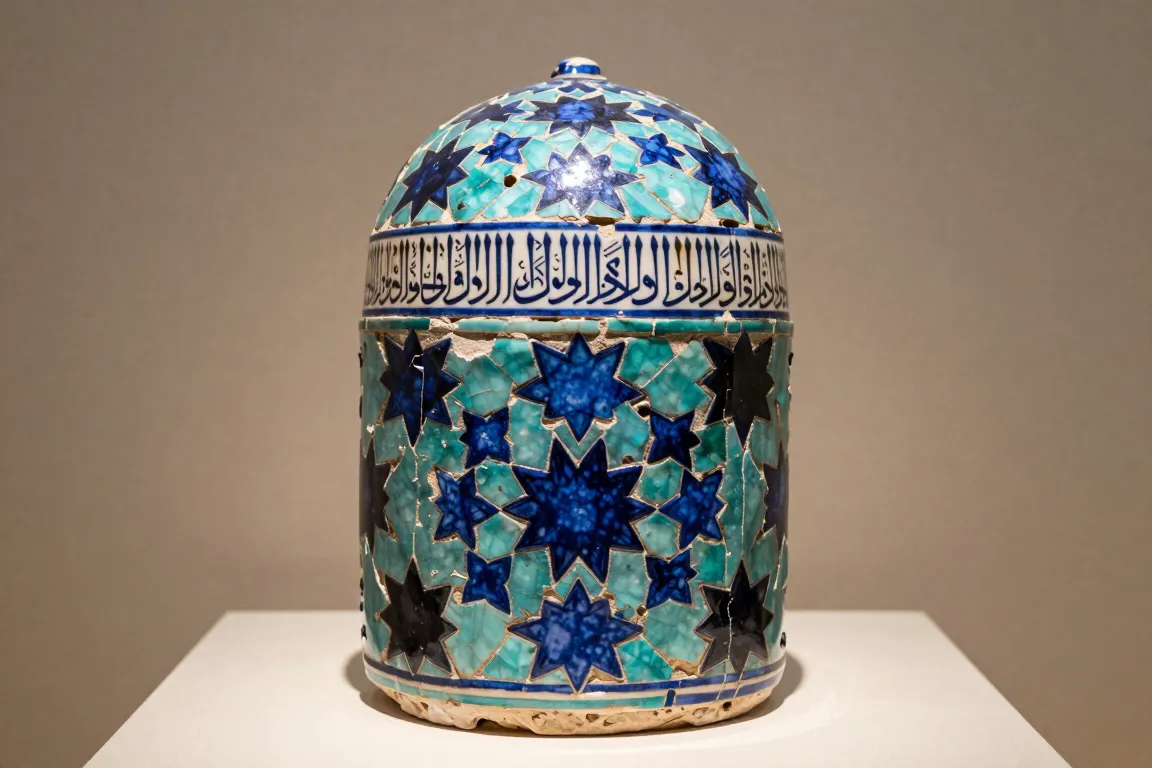
ceramics · 1200–1500 · also: Seljuk tile mosaic, Cut-tile mosaic, Persian tile mosaic
Wall and dome cladding that the Seljuk and Timurid potters made from glazed tiles in one colour. They cut each tile into small shapes and set the pieces together in a geometric or calligraphic pattern.
Core thesis
A building surface becomes a woven pattern of light and colour when many small tiles in turquoise, cobalt and black are cut to fit one geometric plan.
Design principles
Glaze each plain tile in one colour: turquoise from copper, blue from cobalt, black from manganese and iron.
Cut the fired tile with a chisel into the shapes of one pattern: stars, kites, lozenges and calligraphic strokes.
Draw the full pattern first, then set the cut pieces face down on it and pour plaster over the back.
Build the pattern on a grid of 6, 8 or 12 points so that the shapes repeat without a gap.
Use the Kufic script as a band 30 to 60 cm wide, in white or blue on a dark field.
Keep the tesserae 1 to 2 cm thick, with joints under 2 mm, so that the surface reads as one skin.
Place the mosaic on the parts that people look at: the mihrab, the portal and the dome.
Add a few lustre or relief tiles to a flat mosaic for a change of light.
Anti-patterns
A painted pattern on a flat tile, with no cut joints
Figures of people and animals in the mosaic field
Thick grout lines that break the pattern into squares
Bright modern colours such as pink, lime green or orange
A single repeating tile that makes a wallpaper pattern with no cut shapes