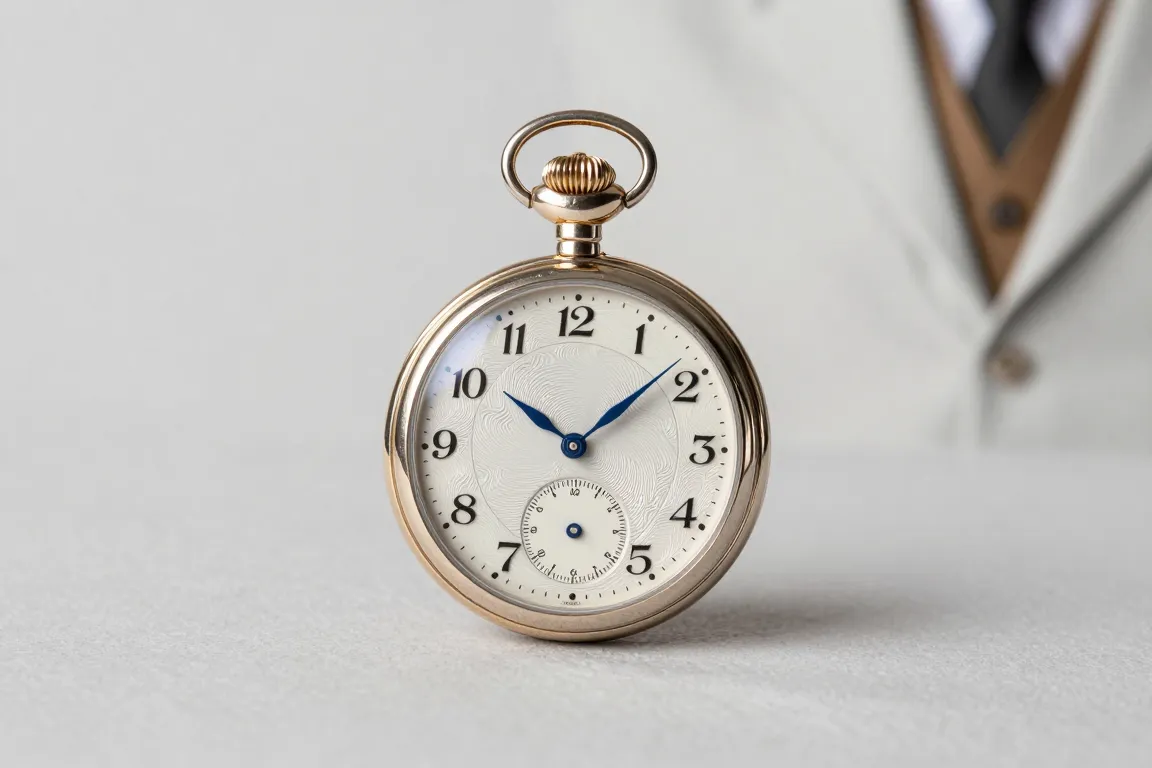
The plain, exact gold watch that Abraham-Louis Breguet made in Paris from 1780. It has an engine-turned silver dial, blued steel hands with an open tip and a coin-edge case. Its movement set the rule for the dress watch.
Core thesis
A fine watch shows its worth by exact work and a quiet face, so each part is plain, thin and cut by hand.
Design principles
Turn the silver dial on a rose engine in a tight pattern of fine lines, checks or barley corns.
Print slim Arabic or Roman numerals and keep the minute track thin.
Blue the steel hands in a flame and cut each tip as an open ring, the Breguet hand.
Cut a fine coin edge on the case band, so that the thumb finds the edge.
Keep the case thin and round: the bow, the pendant and the crown carry no extra ornament.
Put the small seconds dial off centre, at 6 or 10 o'clock, and leave the middle of the dial clear.
Add a secret signature near the 12 that shows only in raking light.
Bend the end of the hairspring in an overcoil, so that the spring opens and closes in an even circle.
Anti-patterns
A crowded dial with bold block numerals
A chrome or steel case with a sport bezel
Printed fake engine turning on a flat dial
Bright coloured hands or a coloured dial
A thick case with large lugs and a heavy crown
Machine-stamped patterns that copy the look of hand turning