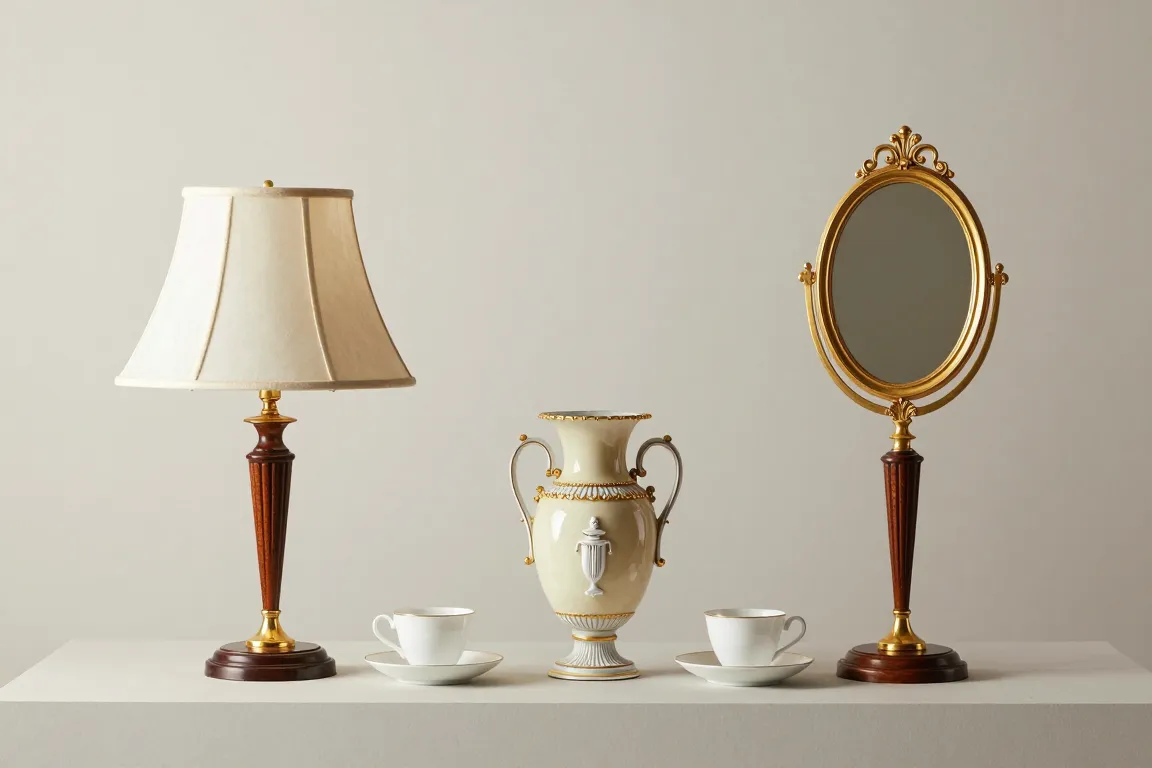
industrial · 1760–1840 · also: Wedgwood and Boulton manufacture, Adam-period manufacture, Georgian factory classicism
The household goods of the first English factories: mahogany furniture, creamware and jasperware, ormolu and Sheffield plate, all made in series from the classical models of the architect and the pattern book.
Core thesis
A factory can make an object that looks like a work of antiquity: the form comes from the classical model, and the mould, the lathe and the die repeat it with a fine finish.
Design principles
Take each form from a classical model: an urn, a column, a vase or an acanthus leaf.
Use a slim, straight leg with 8 to 12 flutes, or a turned leg with a tapered foot.
Use mahogany with a figured veneer and a fine French polish on all large wood surfaces.
Put the ornament in a narrow band: a bead, a reed, a Greek key or a husk chain of 10 to 25 mm.
Make a thin, cast and gilded metal mount for each handle, sconce and clock case.
Keep a pale ground, such as cream, sage or stone, and one gilded accent for each object.
Draw the form so that a workshop can repeat it with a mould, a lathe or a die.
Anti-patterns
Heavy carved scrolls and shells in the rococo manner