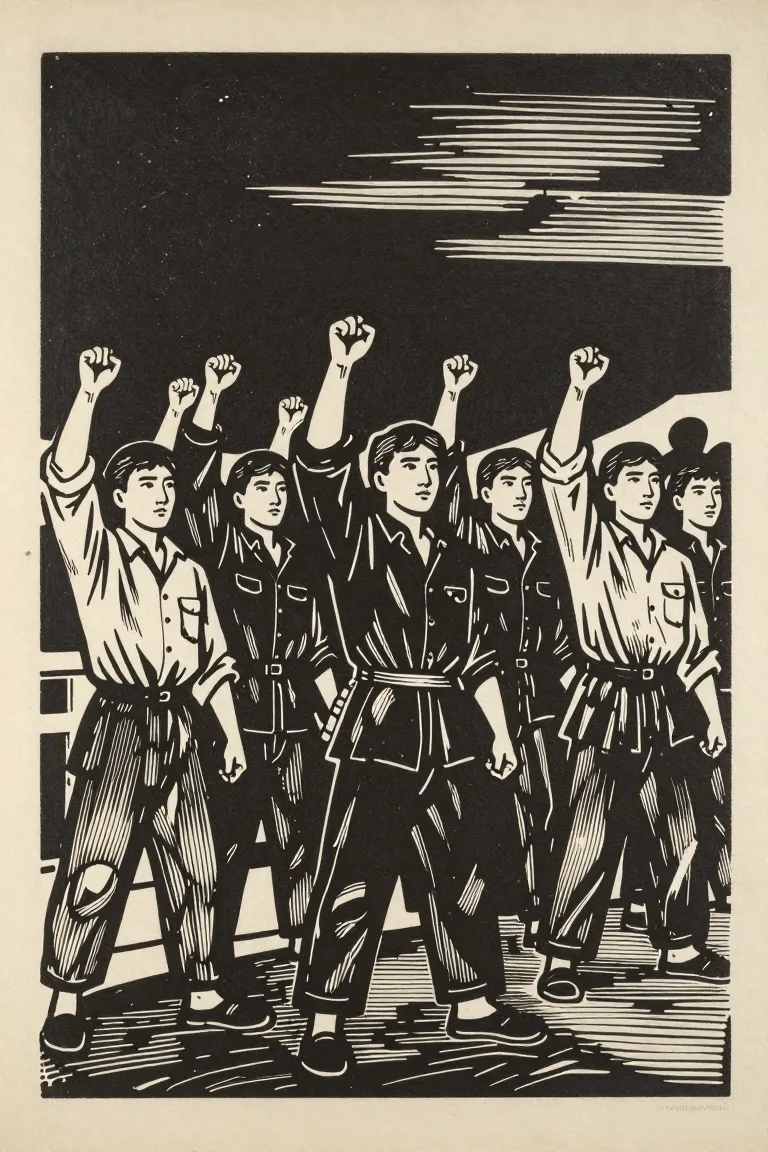
print · 1931–1960 · also: New Woodcut Movement, 新兴木刻运动, Modern woodcut movement
In 1931 Lu Xun urged young artists to learn the European expressionist woodcut of Kollwitz and Masereel. They cut black-and-white prints on cheap wood and printed many on thin paper, bold and rough.
Core thesis
A cheap block of wood and one knife can give a poor and angry public a picture of its own life and its own fight.
Design principles
Cut the block yourself, with a knife, in black ink on white, or in black and one flat colour.
Build the image from heavy black masses and white knife lines, and keep the contrast high.
Choose the people as the subject: workers, farmers, soldiers, a crowd, a portrait of a hero.
Cut the line rough and angular, 0.5–2 mm wide. Leave the knife edge visible.
Allow some cross-cut hatching in the shadow, but keep most tones as a mass or a white line.
Print many copies on thin paper by hand rubbing with a spoon or a baren, so the print is cheap to share.
Add a short caption or a date, and keep the sheet small enough for a magazine page or a wall.