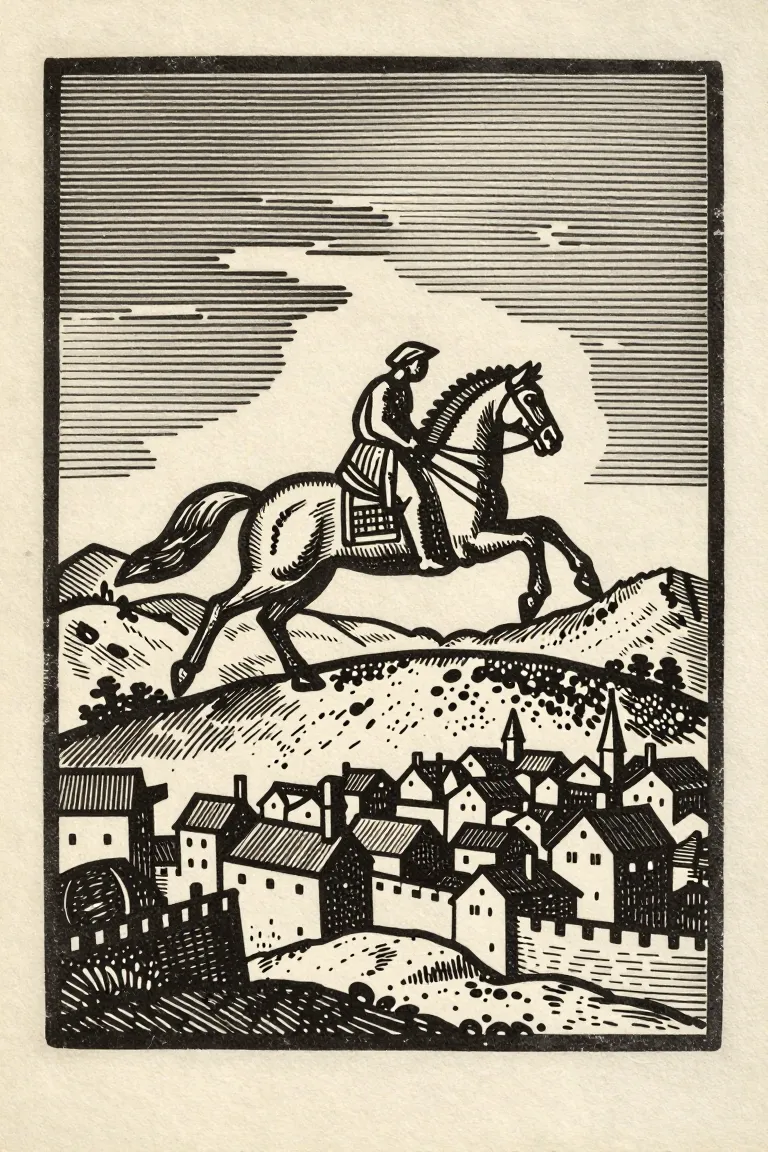
A picture cut into the side grain of a plank: the cutter leaves the lines standing and the press prints them black. In Nuremberg, Wolgemut and Dürer made the cut carry tone with parallel and crossed lines, so one block printed with the type of a book.
Core thesis
A black line that stands on a block of wood can carry form, light and tone if the cutter swells, tapers and crosses it.
Design principles
Draw every tone as black lines on white paper; the woodcut has no grey ink and no screen.
Make the lines 0.3–1.0 mm wide and keep at least 0.5 mm of white between them, so the wood does not break.
Follow the form with the lines: curve the hatching round a body and keep it straight on a wall or the sky.
Swell a line to darken a tone and taper it to a point where the light comes.
Cross the lines only in the deepest shadow, and keep the crossing at about 60°.
Leave large areas of bare paper for light, sky and flesh.
Give each figure a closed, firm contour line of the same weight as the heaviest hatching.
Anti-patterns
Grey wash or a smooth gradient
Lines finer than 0.2 mm, which the wood cannot hold
A halftone dot or a photographic tone
Even hatching that does not follow the form
A contour that is thin and broken like a pencil sketch