Crinoline and bustle dress
fashion · 1856–1889 · also: Cage crinoline dress, Victorian bustle dress, Second Empire dress
The dress of the Second Empire: a vast bell skirt on a steel cage from 1856, then a bustle from 1870, in strong silk.
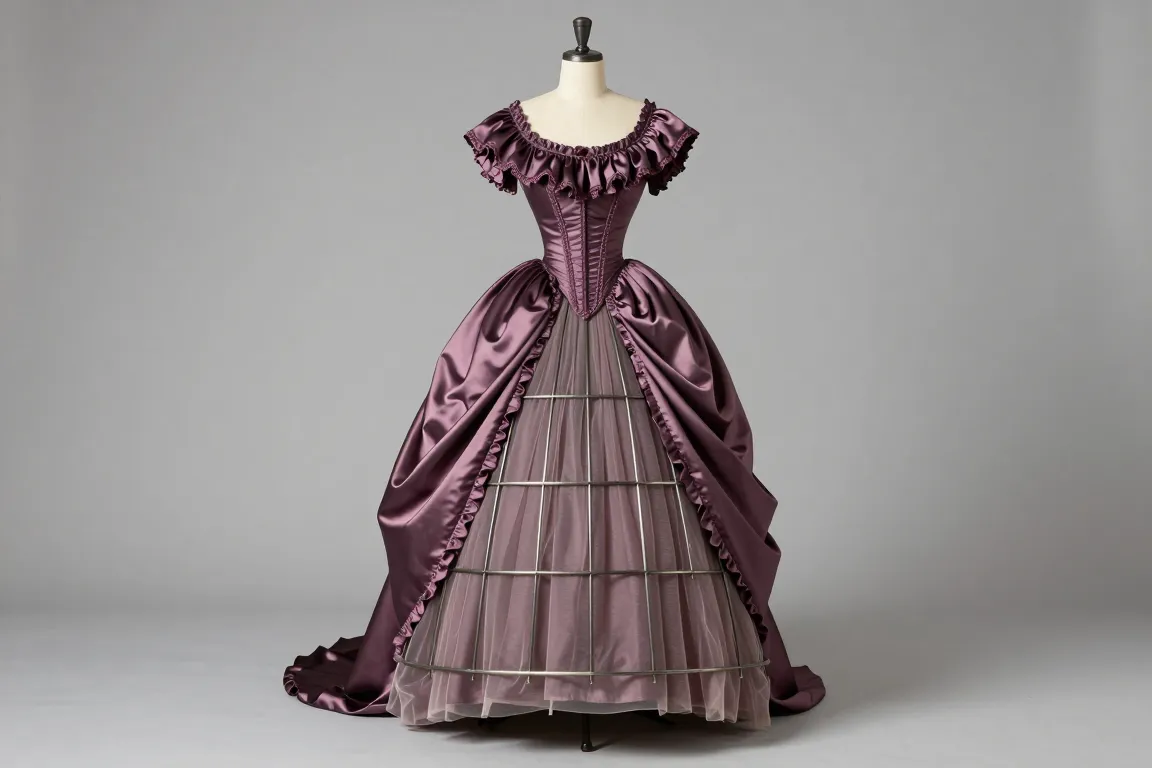
Core thesis
The skirt is the dress: a steel cage and then a bustle carry yards of silk, and the couture house sets the shape each season.
Design principles
- Carry the skirt on a cage of 12 to 20 steel hoops; the hem is up to 3 m across.
- Cut the bodice close to the body, with a pointed front and a waist at 56 to 63 cm.
- Use 10 to 20 m of silk for a day skirt, and up to 40 m for a ball gown.
- In the 1870s, move the fullness to the back on a bustle pad of wire and horsehair.
- Drape the overskirt in swags at the back, and add a train for evening.
- Trim the skirt with flounces, pleats, bows and braid in rows.
- Use the new strong dyes, so that the colour is deep and bright.
Anti-patterns
- A skirt that hangs straight from the waist
- A soft waist with no stays
- Pale muslin with no lining
- A bare, plain skirt with no trim
- A short hem that shows the leg
- Stretch cloth or thin jersey
Palette
Lineage
- Echoes
- Victorian, Victorian manufacture
- Evolved from
- Empire line dress
- Evolved into
- New Look
- Hybridises with
- Straight-Front Corset
- Provoked
- Garçonne and flapper dress
Use it
SKILL.md · tokens.css · source JSON · open in the demo