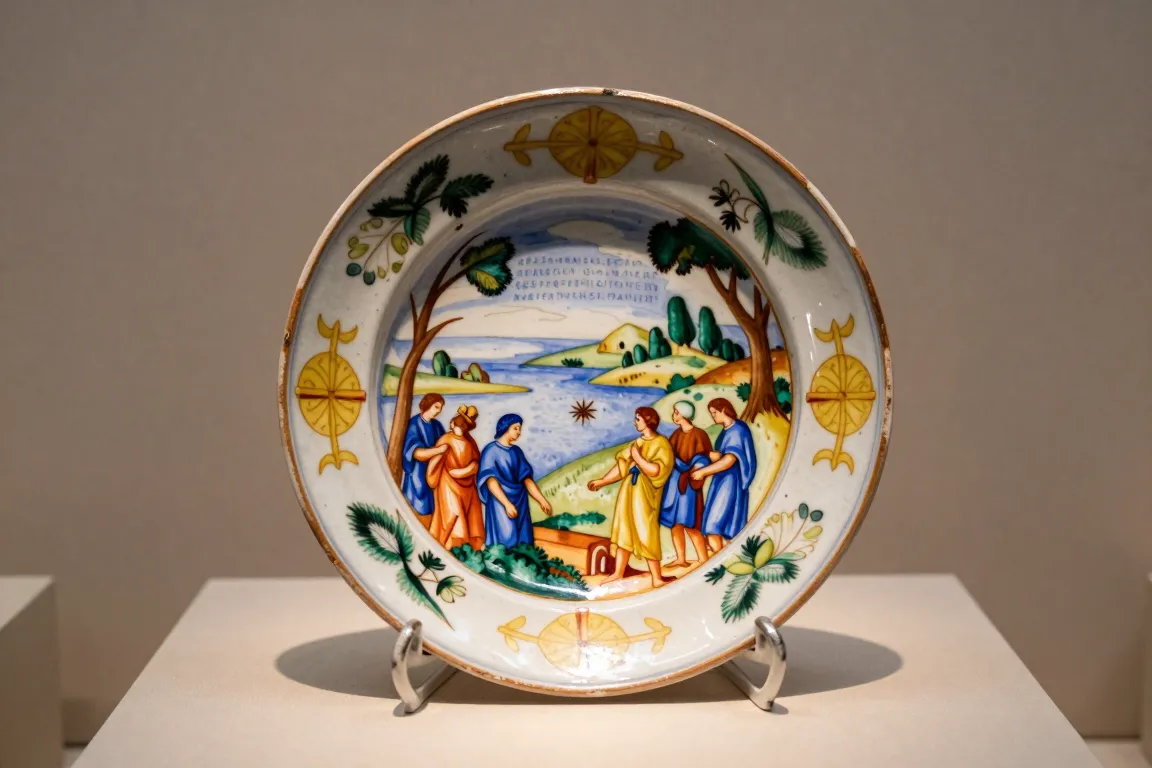
Italian tin-glazed earthenware painted with a whole story, called istoriato. Painters copied scenes from prints and fresco and filled the full surface of a dish with figures in colour.
Core thesis
A dish can be a painting: the whole surface becomes a scene of myth, scripture or history, painted in many colours on white tin glaze.
Design principles
Paint the story over the full face of the dish, with no border or a narrow one.
Copy the figures and the composition from a print, a fresco or a drawing.
Paint on the raw, dry tin glaze with oxides, in one firing, and so make no change.
Use a rich palette: blue, yellow, orange, green, manganese purple and white relief.
Place the figures in the foreground, and a landscape, a sky and a small building behind.
Fire at 950 to 1000 °C, then add lustre in a third firing for the richest pieces.
Write a short title or the maker's mark on the back, or on a banner in the scene.
Anti-patterns
A repeated flat pattern without a story
A cobalt-only painting like blue and white
A thin porcelain body with translucency
Figures drawn with no landscape and no space
Printed or transferred images instead of a painted one