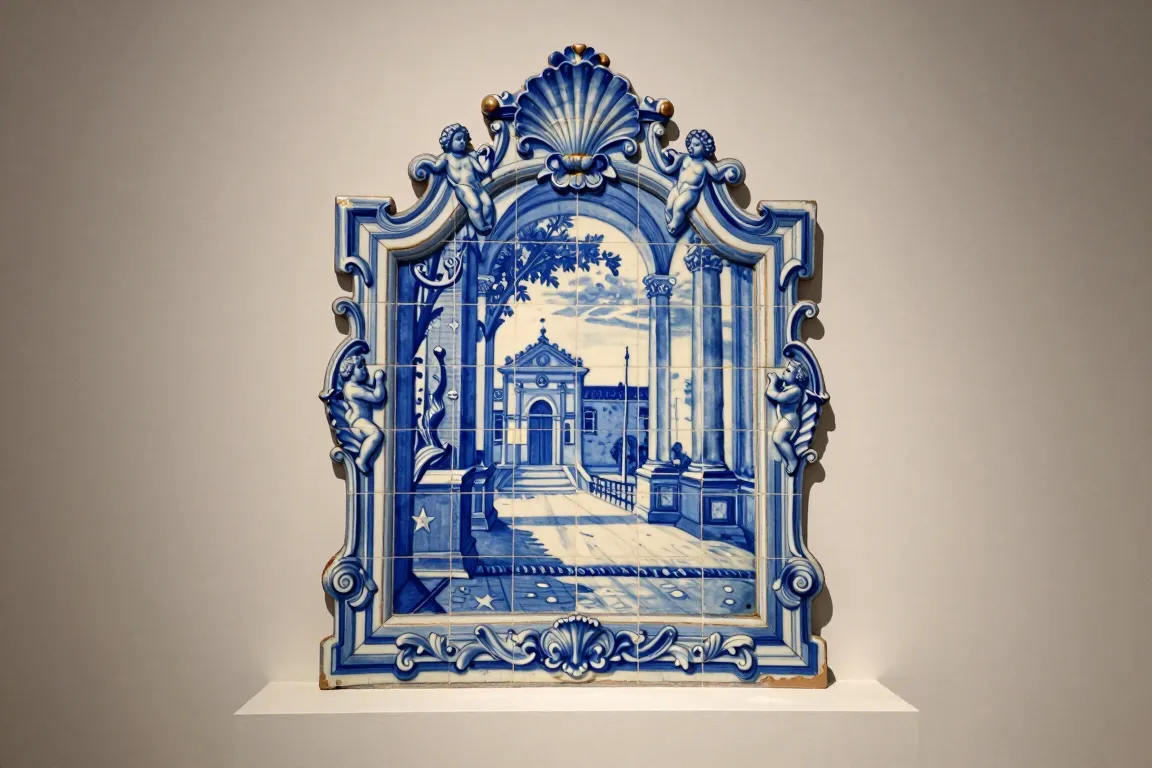
Painted tin-glazed tiles that cover the walls of churches, palaces and streets in Portugal and Spain. A painter works in blue or in many colours on a white glaze, and one scene runs across many tiles.
Core thesis
A wall becomes a picture when many square tiles are painted as one scene on a white tin glaze.
Design principles
Paint the scene on the raw tin glaze, so that each stroke dries at once and cannot be changed.
Plan the scene across a grid of square tiles, about 13 to 15 cm each, and number the tiles on the back.
Use cobalt blue alone for narrative panels; use many colours for pattern carpets.
Repeat a pattern tile in a 2 by 2 or 4 by 4 group to make a carpet of stars and flowers.
Frame a large panel with painted volutes, shells, putti and a cornice.
Cover the wall to the ceiling, or to a dado of about 1.5 m, with no bare patch.
Keep the tile body thin and the glaze thick, about 0.5 mm.
Use a bold blue and yellow in the early pattern tiles and a soft blue in the 18th-century panels.