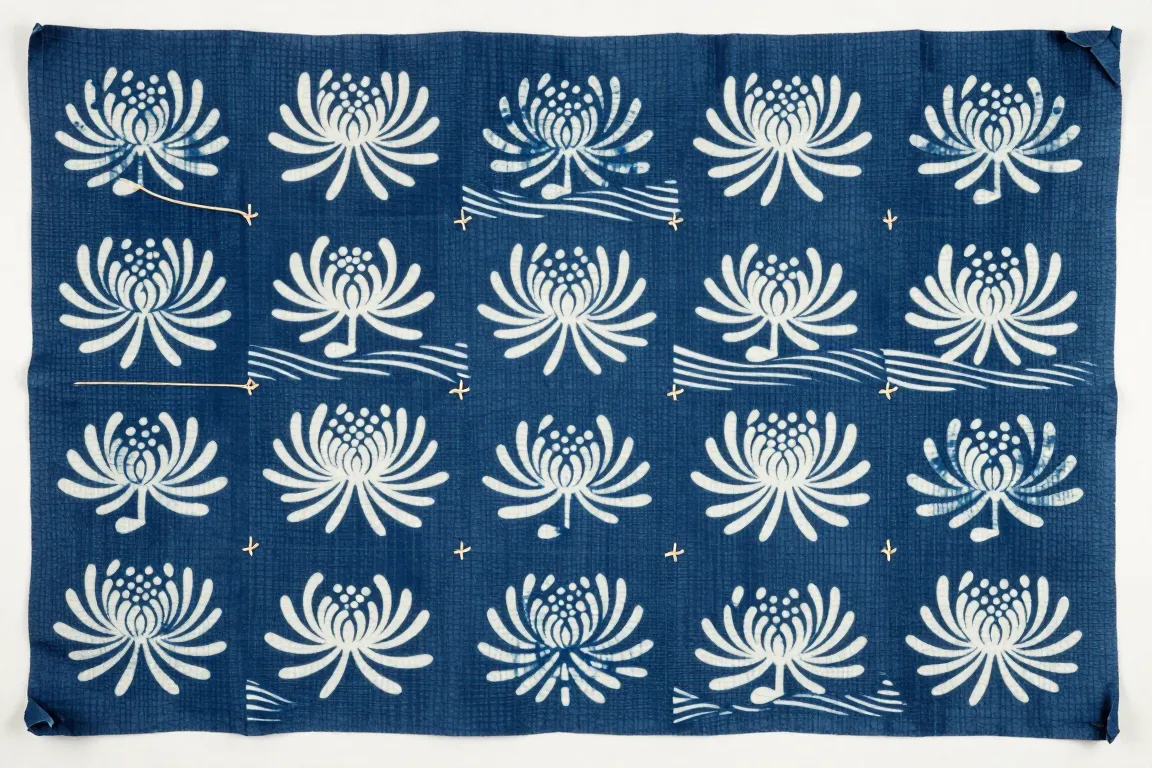
print · c.1600–1960s · also: Katazome, 型染, Ise katagami, 伊勢型紙, Japanese paper stencil dyeing
A stencil is cut in layers of mulberry paper, and rice-paste resist is spread through it onto cloth. The cloth is then dyed. The result is a repeat pattern with sharp white edges and flat colour.
Core thesis
A pattern cut once in paper can be printed a thousand times as a sharp white shape on dyed cloth, if the stencil holds its islands with thin bridges.
Design principles
Cut the pattern in 2–3 layers of washi that are pasted with persimmon tannin (kakishibu), so the stencil stays stiff and wet-proof.
Keep each cut line 0.1–0.5 mm wide, and keep at least 0.5 mm of paper between two cuts.
Hold each free island of paper with a thin bridge, a tie bar, or with a net of silk thread between the layers.
Spread the rice-paste resist through the stencil in one pass of a spatula, and let it dry before you dye.
Dye the cloth after the resist dries. The resist stays white, and the dye fills the rest as a flat colour.
Repeat the pattern on the cloth, and join each repeat so the seam does not show.
Choose a small, fine motif: a wave, a plant, a crest, a bird. Allow a pictorial scene only in mingei work.