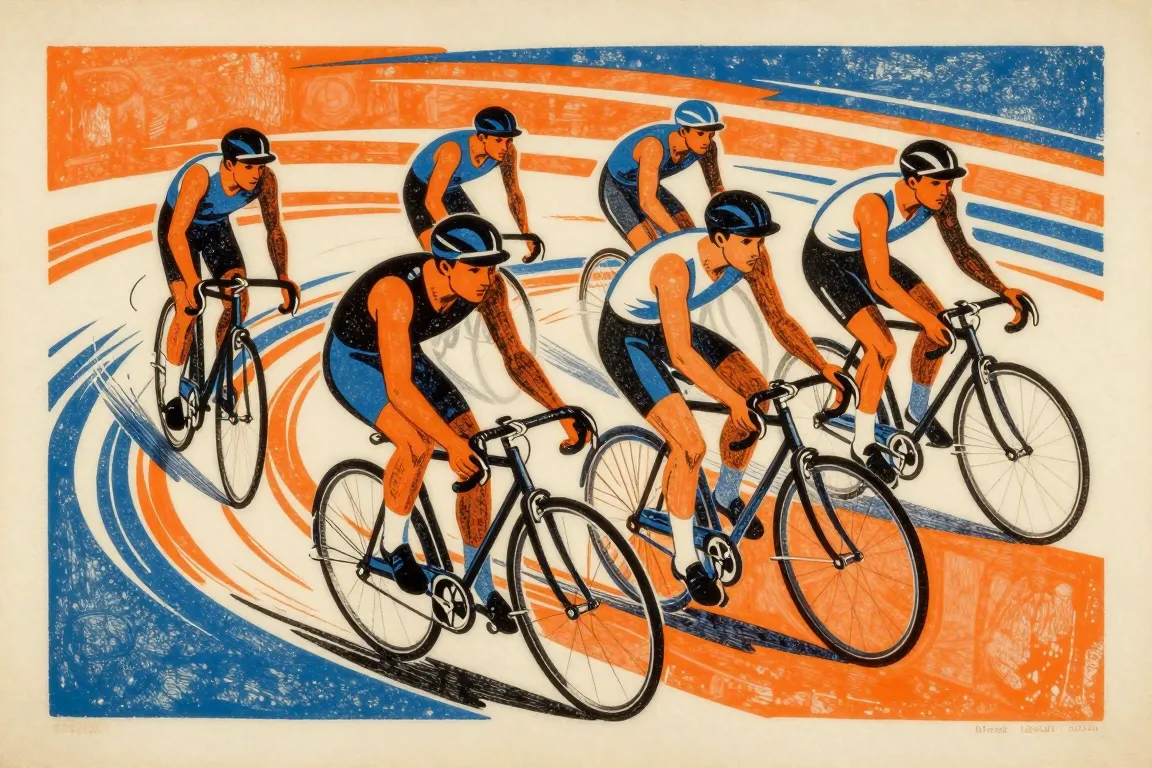
A sheet of linoleum is cut with a V-gouge and printed by hand, so the cut has smooth curves and no grain. Flat opaque colour layers overlap in bold rhythmic shapes, as in the Grosvenor School prints of 1929-1938.
Core thesis
Linoleum has no grain, so a gouge cuts a smooth curve, and flat opaque colour layers can carry rhythm and speed.
Design principles
Cut each colour on its own linoleum block with V and U gouges; the cut makes a smooth curve.
Keep each shape bold: a cut line of 1–3 mm, and a white gap of at least 1 mm.
Print the colours in opaque inks, from light to dark, with 0.5–1.5 mm of offset.
Build speed and rhythm with curved shapes that repeat across the sheet.
Print by hand with a spoon, or on a hand press, on thin Japan paper.
Number the edition under 100, and sign it in pencil.