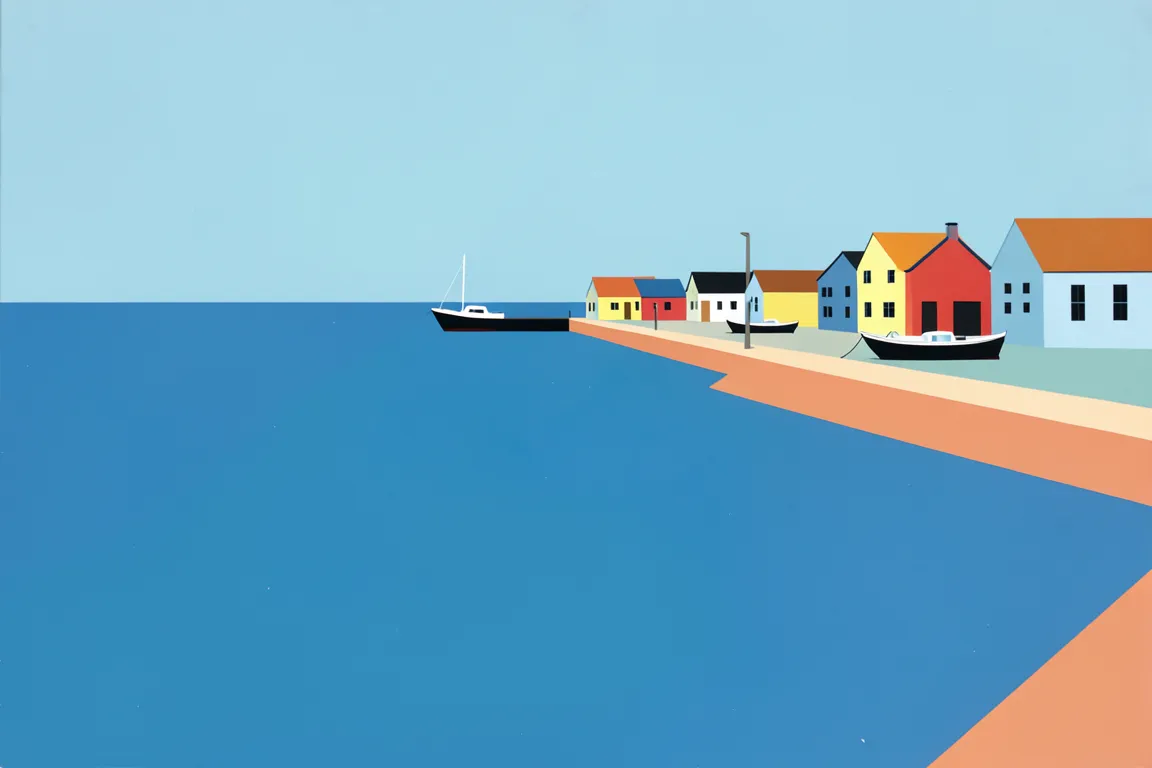
Flat, exact, repeated forms: stripes, grids and bare shapes in one or two colours. The picture is an object with no story and no hand, and the viewer sees what is there.
Core thesis
A picture is a plain object: what you see is what is there, so that form is reduced to the fewest parts and no illusion, gesture or story remains.
Design principles
Reduce the picture to 1–3 elements: a stripe, a grid, a bar or a single shape.
Repeat one unit, such as a stripe of 40–80mm, 8–40 times, in a strict order.
Paint flat, even coats with no stroke, and keep the edge sharp to under 1mm.
Limit the colour to 1–3 hues, or to black, grey and white, with no mixing and no gradient.
Let the shape of the canvas follow the pattern: a notched, shaped or very wide support is fine.
Fix the system before the painting starts, and follow it with no change by taste.
Give the picture no title that tells a story and no sign of the hand.