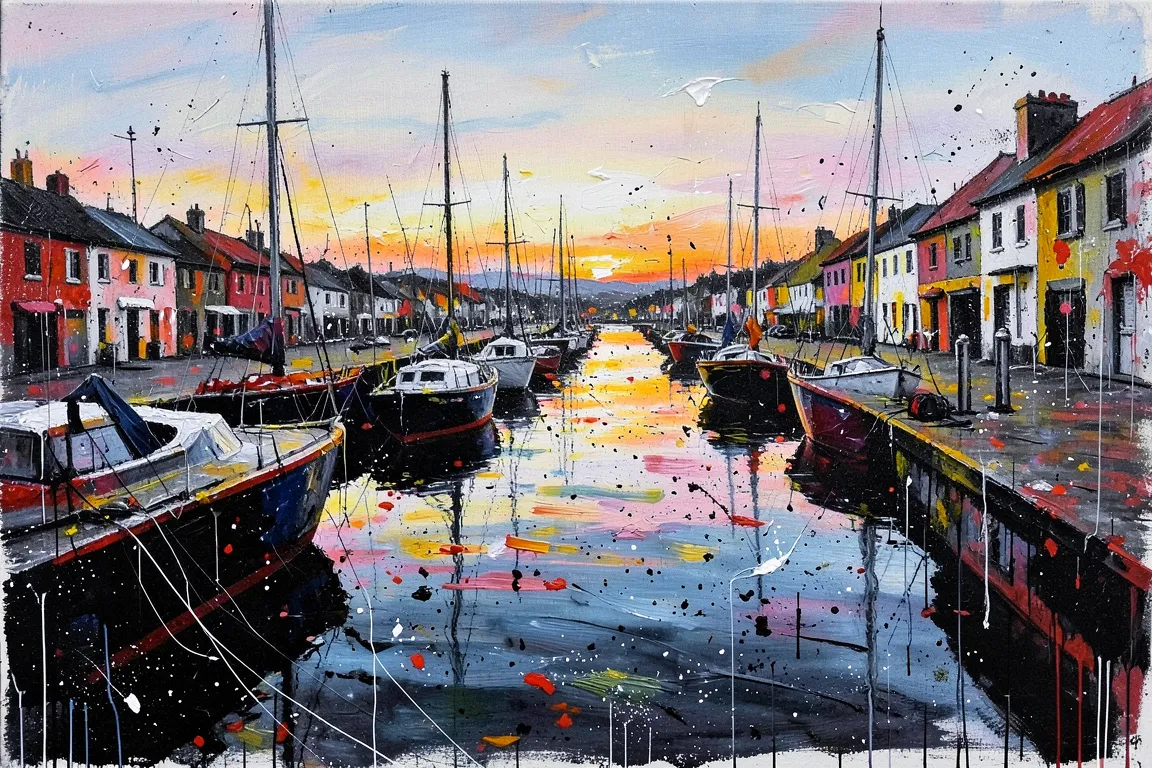
painting · 1940s–1960s · also: Action painting, New York School, Colour Field (early)
Large abstract paintings in which the act of painting is the subject: gesture, drip and slash in one camp, large soft fields of colour in the other. The canvas is an arena for an event, and it is big enough to surround the viewer.
Core thesis
A painting is the record of an act, and its scale, its marks and its colour put the viewer inside the feeling and not in front of an image.
Design principles
Paint at a scale of 2 to 5m on the long side, so that the canvas fills the field of view at a distance of 1–2m.
Show every mark: stroke, drip, splash and scrape at 20–200mm, laid by the whole arm and not by the wrist.
Cover the canvas edge to edge in an all-over composition, with no single focal point and a similar density at the edges and the centre.
Drop the object entirely; the picture refers to nothing outside its own marks.
Hold a deliberate tension between a few opposed forces: black against white, thick against thin, order against chance.
In the colour-field branch, replace the mark with 2–4 large, soft-edged fields of thin colour stacked vertically.
Keep the first mark visible: show corrections, drips and the traces of the process.
Anti-patterns
Recognisable objects, figures or landscape
Hard, ruled edges and mechanical straight lines
A small format that can be read as a vignette
A smooth, even surface that hides the process
A central focal point with a framed, symmetric layout