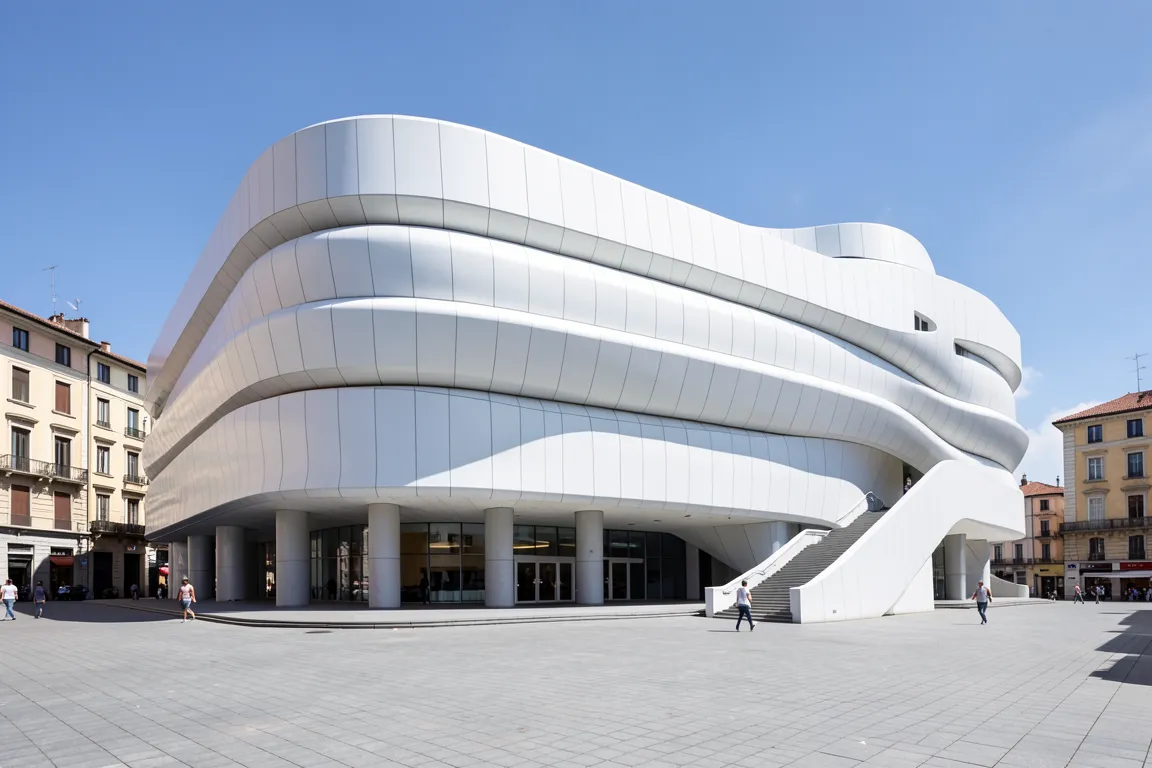
Buildings drawn by algorithm: continuous curved skins, smooth transitions and no repeated part. Zaha Hadid Architects and Patrik Schumacher made one flowing field of the façade, roof and floor, built with digital fabrication.
Core thesis
A design is a system of linked parameters, so every part can differ and follow the others in a smooth gradient: one fluid field replaces the rigid, repeated element.
Design principles
Replace the rigid, repeated element with a continuous surface: roof, wall and floor fold into one another without an edge.
Drive the form by parameters: structure, daylight, flow of people and fabrication limits set the shape by script.
Differentiate the parts in a smooth gradient, so each panel, mullion and node differs a little from its neighbour.
Use a double-curved skin of panels with a typical size of 1.5 to 3m, and a hidden steel space frame under it.
Make the plan a field: paths, rooms and the landscape flow together, and the route has no sharp corner.
Design with digital tools from first sketch to fabrication, so the model is also the shop drawing.
Anti-patterns
Orthogonal boxes, repeated identical bays and flat facades
Applied historical ornament or a symbolic pastiche
Sharp, unrelated shards with no continuity of surface
Random blob forms with no link to a parameter
A single repeated module over the whole skin
Visible joints and edges that break the flow of the surface