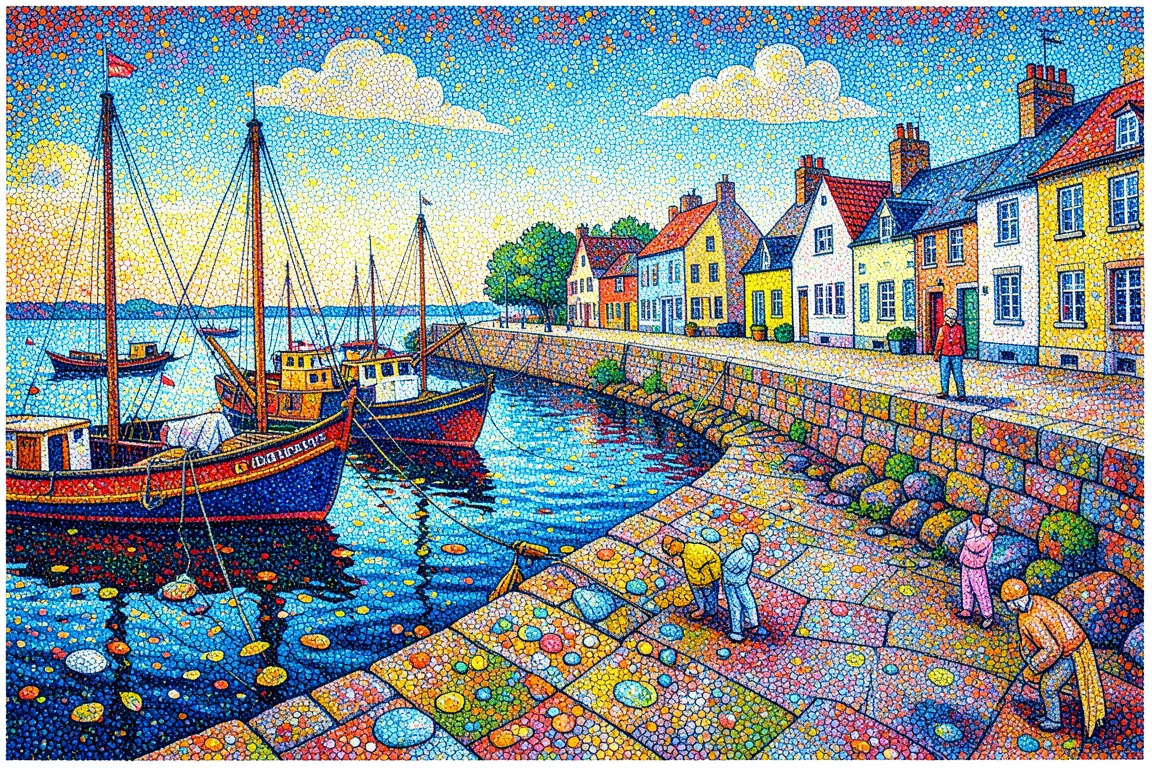
A picture made of small, separate dots of pure colour that the eye mixes at a distance. The scene is still and ordered, built by colour theory and not by blending.
Core thesis
Colour is a science: pure dots set side by side mix in the eye with more light than a mix on the palette, and a picture can be built by rule.
Design principles
Lay each dot as a separate touch of pure colour, 2–5mm across, with a ground that shows between them.
Mix by juxtaposition: set complementary pairs, such as orange and blue, next to each other, so that the eye fuses them.
Build each area from 3 elements: local colour, light (warm) and shadow (cool complement), plus a reflected colour.
Hold the scene in still, simple masses: a frieze of figures in profile and in full face, in a clear, ordered space.
Plan the picture on a grid or a golden-section armature, with strong verticals and horizontals.
Add a painted border in the colour that contrasts with the edge of the scene.
Use a matt, chalky surface so that the dots stay pure and bright.