architecture · 1960s–1990s · also: Postmodern architecture, PoMo, Historicist modern
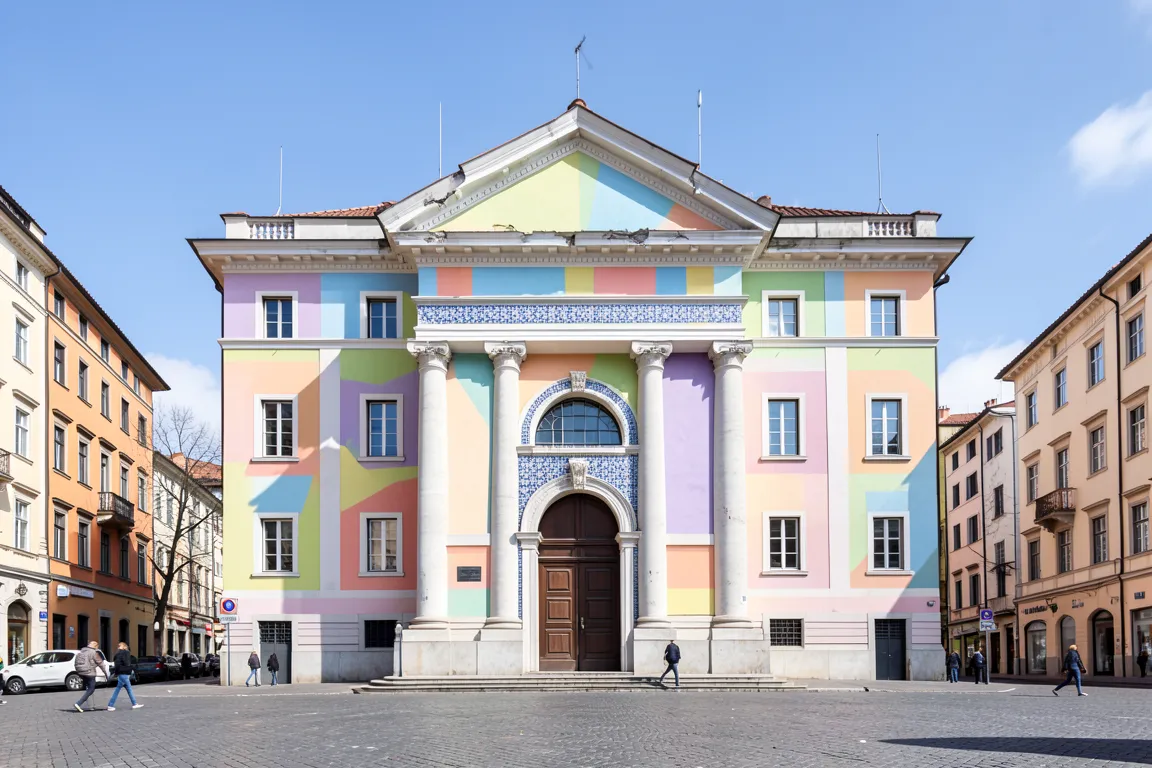
A building that quotes history in a joke and in colour: split pediments, giant keystones, pastel stone and a facade that works as a sign. Venturi, Graves and Johnson used it to answer the blank box of the Modern Movement.
Core thesis
Architecture is communication: a building should carry meaning, memory and irony, and a decorated shed is better than a blank box.
Design principles
Quote a historical form in a changed scale, colour or material: a keystone 3 times too large, or a column in plywood.
Compose the front as a sign: a flat facade of 2 to 4 distinct layers, with the entrance and the title marked as a symbol.
Split and layer the classical elements: a broken pediment, a cut column, a loggia that is only a picture of a loggia.
Paint the building: use 3 to 5 flat pastel colours in large fields on stone, render and tile.
Combine two or more codes in one front, popular and learned, and let the contradiction show.
Make the entrance a stage: a tall arch or portal of 6 to 10m, with a bright lobby behind it.
Anti-patterns
Blank, unadorned glass or concrete boxes
Faithful copies of a historical style with no irony
A single material and a single colour over the whole front
Structure shown as the main image of the facade
Rigid, purist geometry with no historical quotation