Rococo court dress
fashion · 1720–1789 · also: Robe à la française, Louis XV court dress, Watteau-back gown
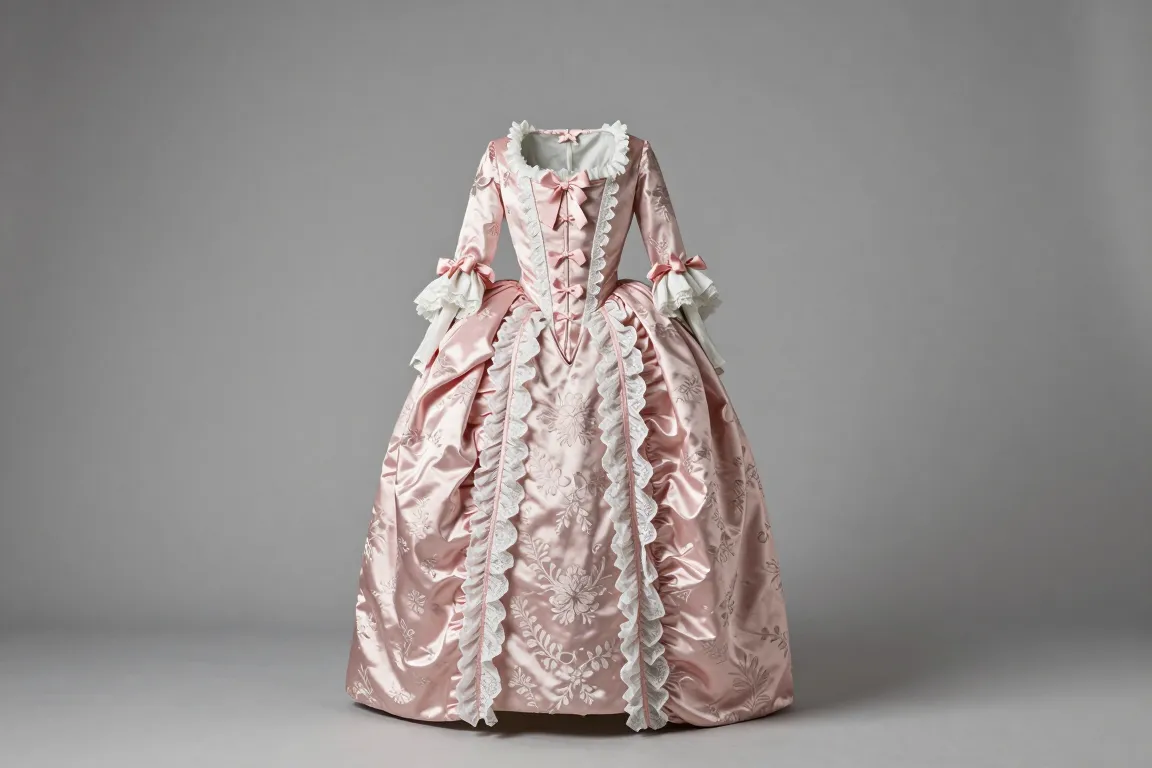
The court dress of Louis XV: a wide-hipped silk gown with Watteau back pleats, lace ruffles and flower brocade, copied at the courts of Europe.
Core thesis
A court gown shows rank by the width of the skirt, the weight of the silk and the hours of hand work in the trim.
Design principles
- Hold the skirt out on side hoops 1 m across for day and up to 3 m across for court.
- Boned stays shape the torso into a stiff cone; lace the stays tight so that the back stays straight.
- Cut the back as two box pleats that fall free from the neck to the floor (the Watteau pleat).
- Open the front of the skirt over a petticoat in the same silk or a contrast silk.
- Fill the V of the bodice with a stomacher, and cover it with bows or embroidery.
- End the sleeve at the elbow in two or three tiers of lace ruffles.
- Choose small flower sprays on a pale ground; keep the brocade pattern in scale with the skirt.
Anti-patterns
- A straight, narrow skirt with no hoops
- Heavy, dark, plain wool for a court gown
- A high neckline with no lace at the elbow
- Stiff, large, geometric prints
- A waist at the natural line with no point at the front
- Visible machine seams
Palette
Lineage
- Echoes
- Georgian, Rococo, Rococo porcelain figures, Sèvres rococo porcelain
- Provoked
- Empire line dress, English bespoke tailoring
Use it
SKILL.md · tokens.css · source JSON · open in the demo