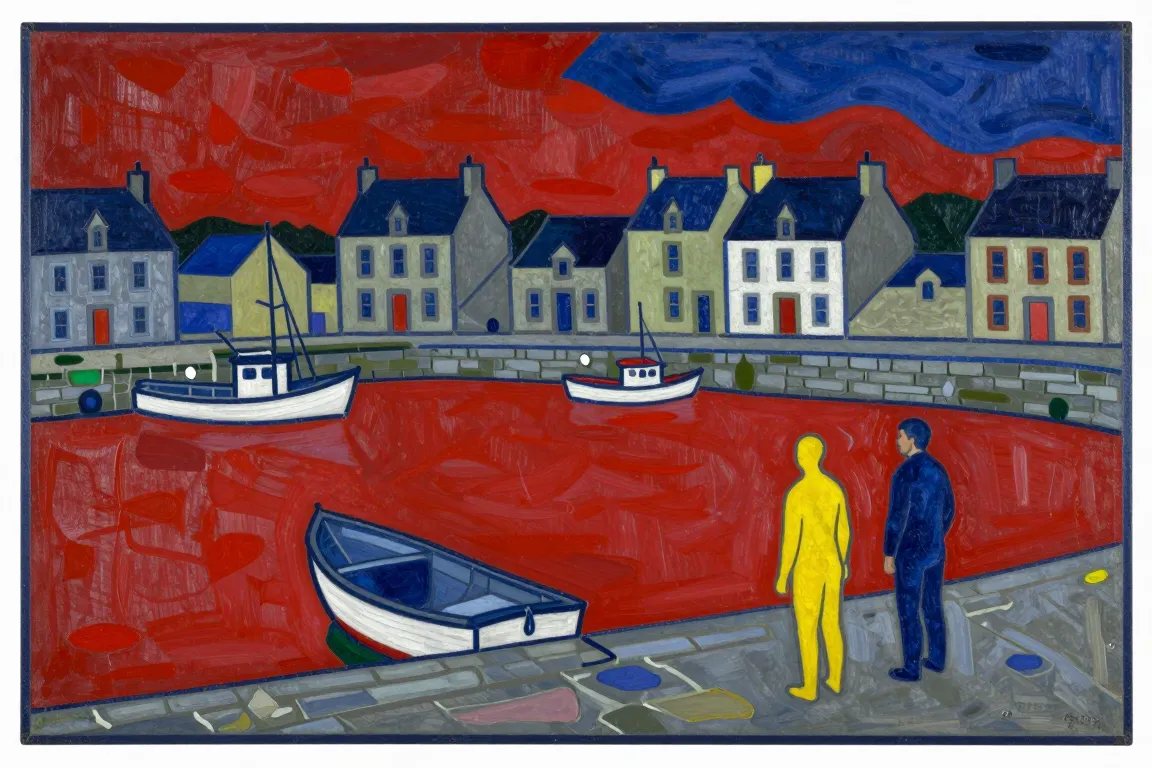
Flat areas of pure colour held by a dark outline, painted from memory and feeling. The painter combines the seen scene, the feeling and the pure form of line and colour into one simple, decorative picture.
Core thesis
A picture should join the thing seen, the feeling of the painter and the pure form of colour and line, and it should not copy the scene from the eye.
Design principles
Fill each shape with one flat colour and no gradient, in a patch of 30–300mm.
Draw a dark blue or black contour of 3–8mm around every patch, like the lead of a stained-glass window.
Choose colours by feeling and not by nature: a red field, a yellow Christ, a blue tree.
Flatten the space to 2 layers, with no cast shadow and no single-point perspective.
Set the shapes in a rhythm of curves, and cut the scene by a tree or a high horizon at 10–20% from the top.
Paint from memory and from sketches, so that detail is lost and the main form stays.
Choose a simple, devout or rustic subject, such as women at prayer, a field, a calvary or a farm.