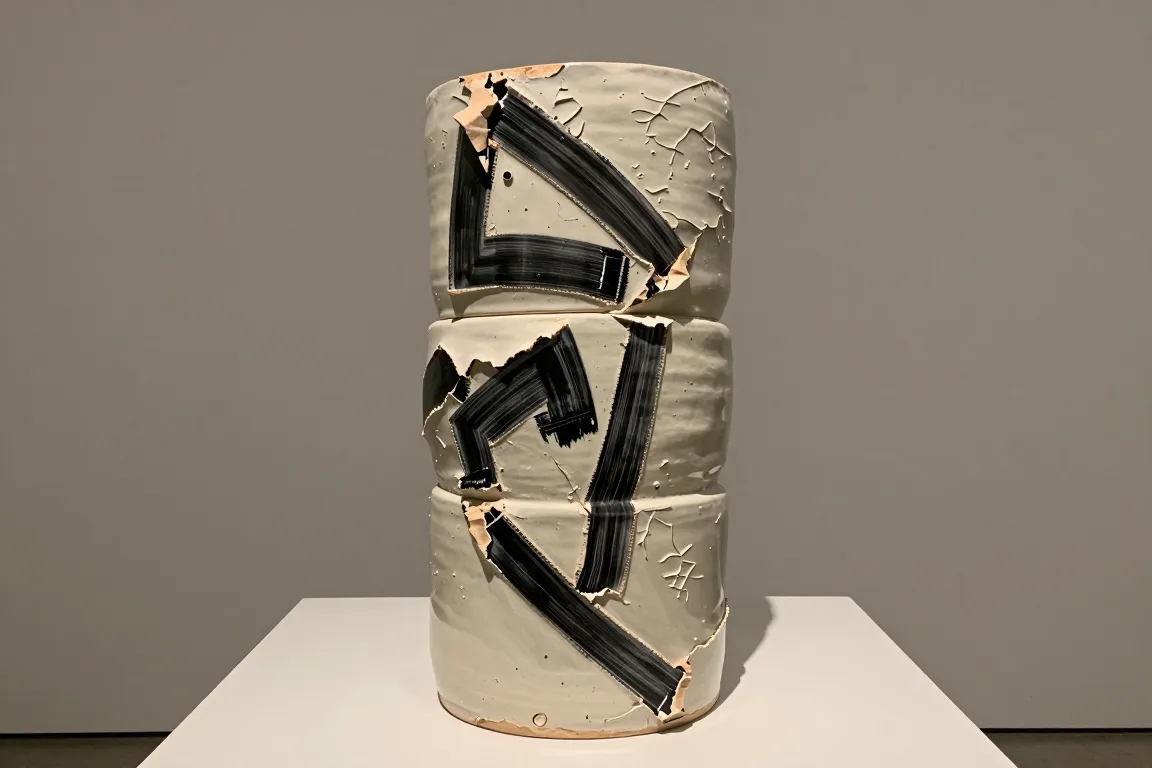
ceramics · 1954–1975 · also: Otis group ceramics, Voulkos school, Clay as sculpture
American ceramics after 1954 in which the potter treats the vessel as a sculpture. Peter Voulkos threw large forms, cut, tore and stacked them, and painted them with the gesture of action painting.
Core thesis
The pot is a place for a gesture: a thrown cylinder can be cut, torn and stacked like paint on a canvas, and the use of the vessel no longer sets the form.
Design principles
Throw large cylinders of 40 to 100 cm, in 3 to 5 parts, and join them while they are soft.
Cut, tear, paddle and puncture the thrown wall so that the action stays visible.
Stack the parts into a tall, uneven form, with open holes that show the inside.
Paint the clay with thick slip and iron in broad gestures, as an action painter paints a canvas.
Use thick, raw glazes: black iron, ash and tenmoku, with runs and bare clay patches.
Fire in a gas kiln in reduction at 1200 to 1300 °C; accept the cracks and the warps.
Leave a vessel opening, a lid or a spout as a sign of the pot, even when the pot cannot hold liquid.
Work fast and in a group, and call the studio a place of work, not a pottery.