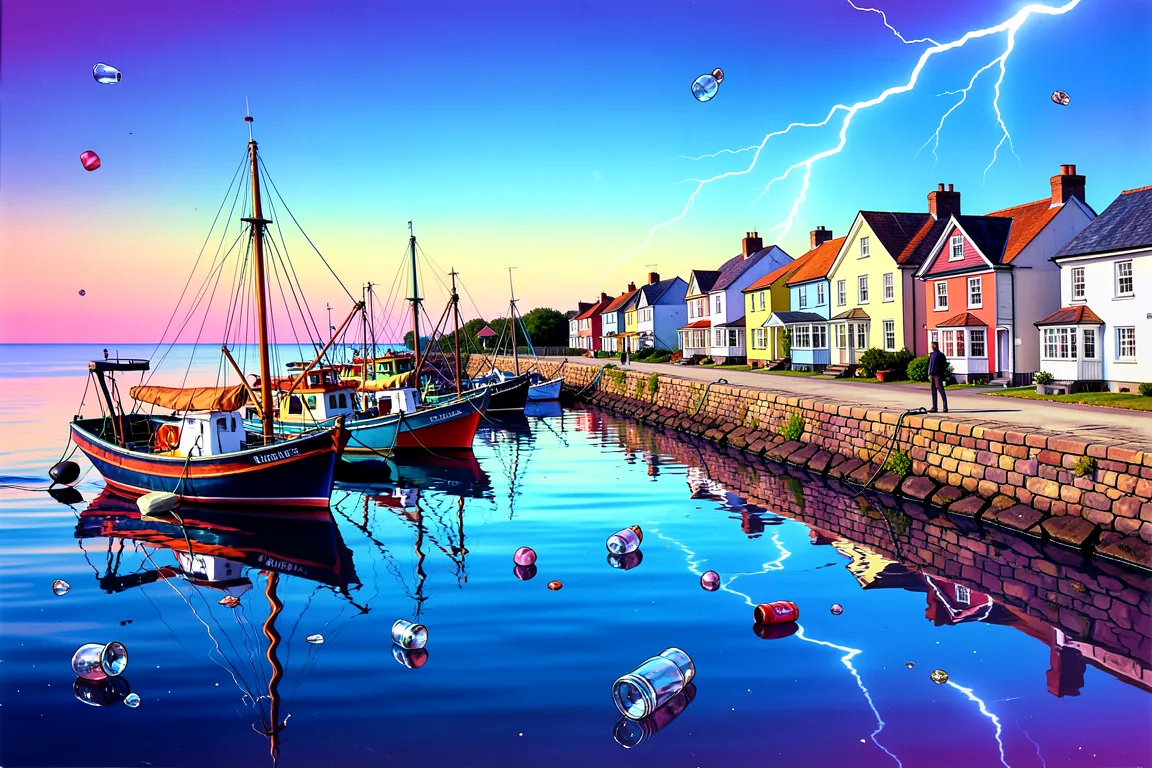
Surreal airbrushed illustration: supersaturated colour, floating or juxtaposed objects, chrome surfaces, lightning and X-ray cut-aways. It lived on album covers, pulp science fiction and fantasy, and pin-up chrome robots.
Core thesis
A dream can be rendered as a polished object: the airbrush gives an impossible scene the smooth, lit surface of a photograph.
Design principles
Build every form with airbrushed gradients and no visible stroke: a sphere or a tube holds a smooth tonal run of 8 to 12 steps from highlight to core shadow.
Render chrome and metal with a sharp horizon line in the reflection: a sky band over a dark ground band, split at 50% of the form height.
Place 2 to 4 unrelated objects in one scene, juxtaposed or floating, with a clear gap of 5 to 15% of the picture between them.
Raise saturation to the top of the range in the sky and in glows: use 3 to 5 hues, such as electric blue, magenta and orange, at full chroma.
Cut hard edges with masking film: each shape has a crisp edge of 0.5mm or less, and each glow has a soft edge of 20 to 60mm.
Add one light effect, such as a lightning bolt, a lens flare or a halo, that crosses 30 to 50% of the picture.
Show the inside of a body or a machine in one X-ray cut-away, with the outer skin stopped at a clean line.
Set the horizon at 1/3 from the bottom, in a flat plain or a sea, so that the objects stand in a deep, empty space.
Anti-patterns
Visible brush strokes and impasto in the paint
Muted, earthy or tonal palettes
Soft, hazy focus with no crisp mask edge
A single, realistic scene with no impossible element
Neon grid, wireframe and digital glow from later computer imagery
Hand-drawn contour lines of uniform weight around each form