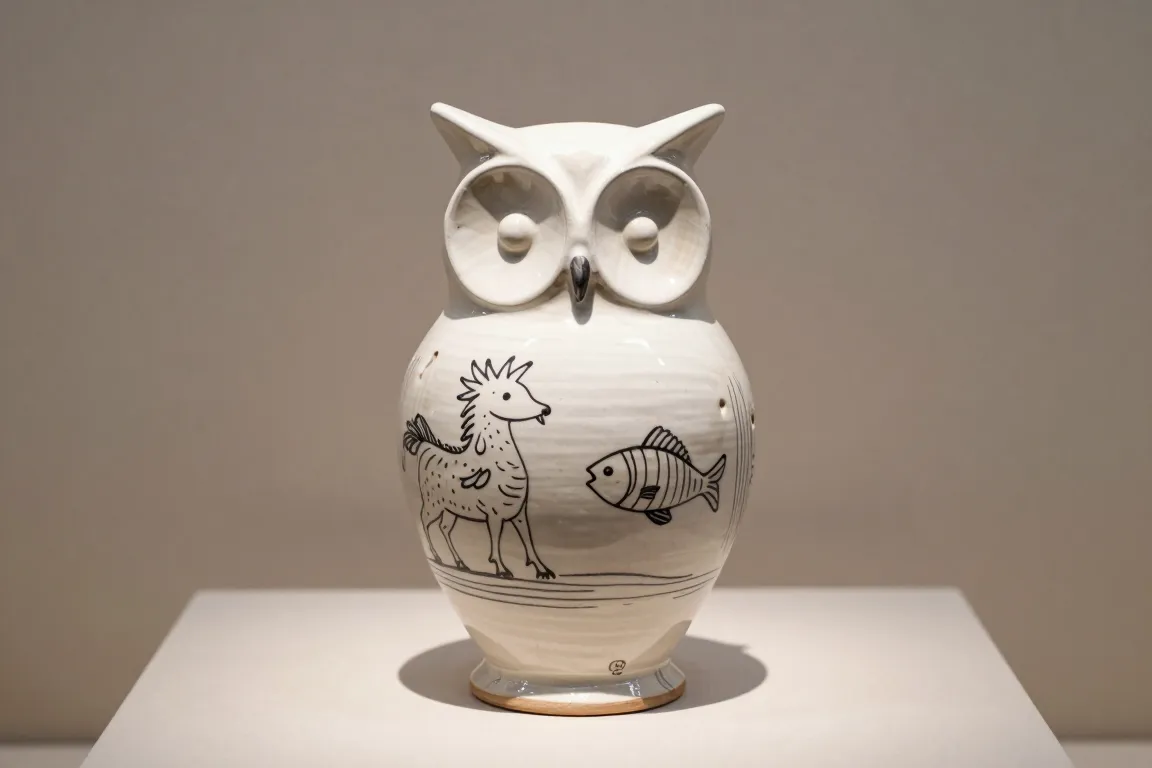
Ceramics by painters and sculptors at the Provençal potteries of Vallauris. Picasso made thrown vases into owls, bulls and women, and painted plates in engobe and wax resist, in editions of a few hundred.
Core thesis
A painter treats the potter's vase as a body and the plate as a canvas, and plays with the craft in a joyful, quick and plain way.
Design principles
Start from a thrown form: a bottle, a jug or a plate by the potter's wheel.
Alter the form by hand while it is wet: pinch, bend, cut and join to make an owl, a woman or a bull.
Draw on the leather-hard clay with a knife, and cut lines through a coat of slip.
Paint with engobes in black, white, ochre and green, and use wax to resist the glaze.
Keep the line quick and plain, as in a drawing: a few strokes make a face, a fish or a faun.
Use a white or red earthenware, and leave parts of the clay bare.
Make an edition of 25 to 500, with a stamp or an incised mark of the pottery and the artist.
Choose Mediterranean subjects: fauns, fish, bulls, owls, doves and women.
Anti-patterns
A fine, polished factory finish with no line of the hand
A sentimental figure with a realistic face
A matt industrial glaze in a single flat colour
A thick transfer print or a printed decal
A heavy, rough peasant pot with no drawn line
A symmetrical pattern that fills the whole surface