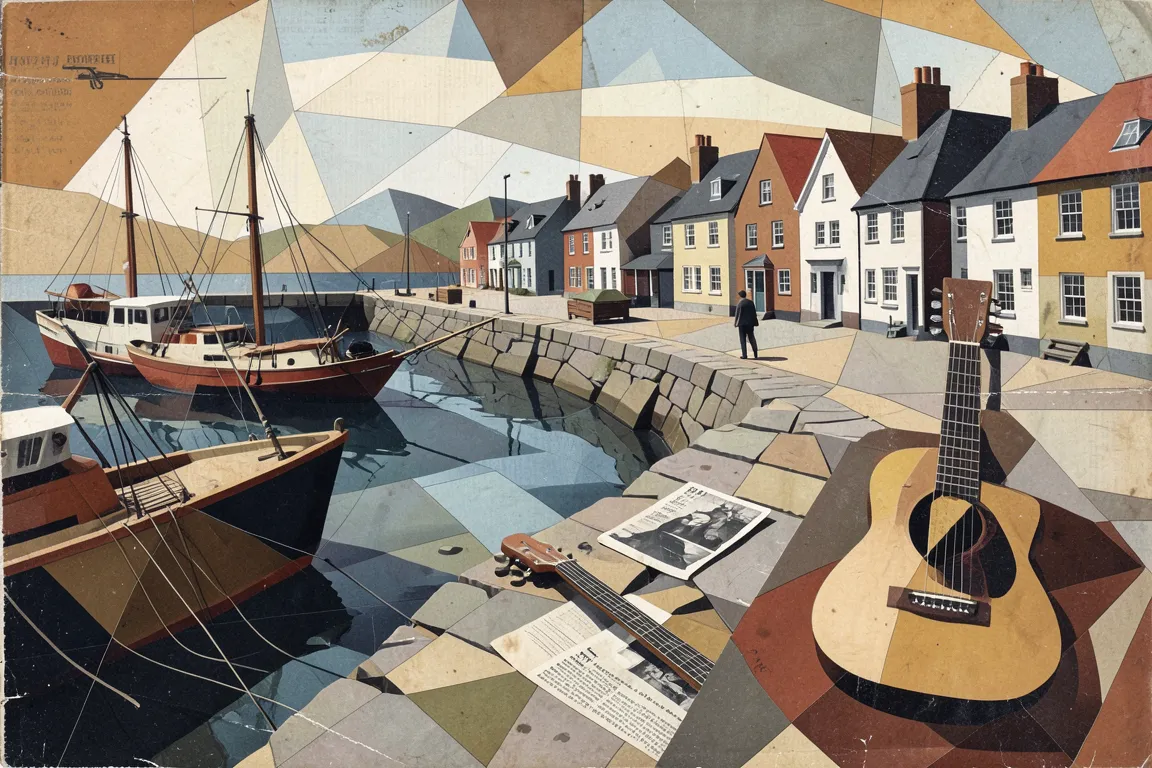
A picture that shows an object from several sides at once. Analytic Cubism breaks the subject into faceted planes in a narrow brown-grey key; Synthetic Cubism rebuilds it from flat shapes, pasted paper and brighter colour.
Core thesis
A picture is an object in its own right, and it shows what a thing is by combining several viewpoints on one flat surface.
Design principles
Break the subject into 20–60 planes with mostly straight edges, and show each plane from a different viewpoint.
Keep the space shallow: stack planes in 2–4 layers that lean forward and never open a deep perspective.
In the analytic phase, limit the palette to 3–4 hues of ochre, grey, brown and olive.
Make the contour pass through the form: let edges open, so that figure and ground exchange places.
Set a grid of verticals and horizontals as the armature, and tilt the planes 5–20° from it.
In the synthetic phase, use flat shapes in solid colour, and add real texture: pasted paper, sand, a stencilled letter.
Choose a plain, close subject that stands on a table: a guitar, a bottle, a glass, a newspaper, a head.
Anti-patterns
Deep single-point perspective with a receding floor
Smooth modelling that turns a form as one solid volume
Soft atmospheric edges and blended colour
A single viewpoint and a full, undistorted face
Strong cast shadows from one light source
Sentimental or narrative subjects that need a story