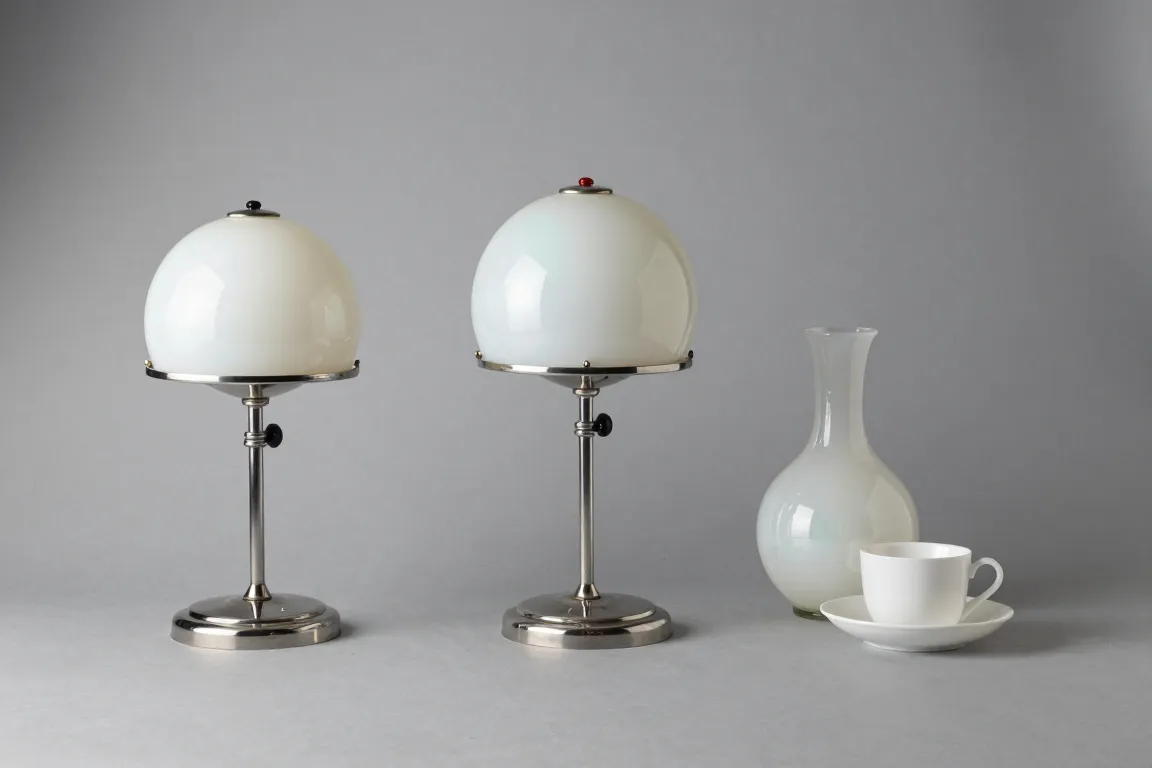
The workshop objects of the Bauhaus: lamps, tea sets and chairs built from the sphere, the cylinder and the cone in nickel, chrome, opal glass and bent steel tube, as models for mass production.
Core thesis
An everyday object is a model for the factory: its form comes from plain geometry, its material and its use, and ornament has no place on it.
Design principles
Build each body from a sphere, a cylinder, a cone or a cube; show the solid, not a style.
Make each part do one job, and let the eye read the job: a stem carries, a shade spreads light, a handle holds.
Use bent steel tube of 20 to 25 mm for the frame of a seat or a table, and leave it bare and chromed.
Use opal glass for a diffuser, and nickel or chrome for the metal parts.
Keep the surfaces smooth and free of ornament; a screw or a joint stays in view.
Keep colour to the colour of the material, with black, white and one primary colour at most.
Draw each object so that a factory can make it in series from standard parts.
Anti-patterns
Applied ornament, a moulded leaf or a scroll
Revival forms that copy a past style
Hidden joints that pretend the object is one piece