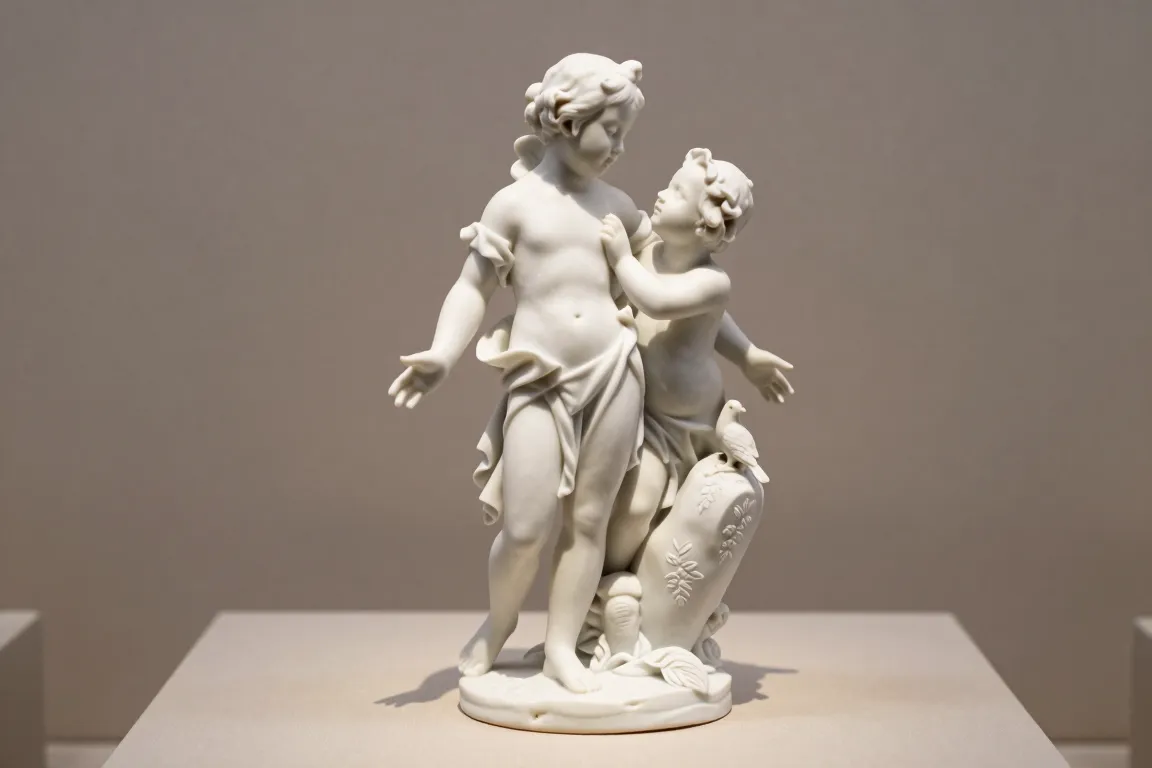
Unglazed white porcelain figures that look like marble and show the form with no colour. Vincennes and Sèvres made them after the paintings of Boucher and the models of Falconet, for the dessert table and the shelf.
Core thesis
When the glaze and the colour are gone, only the form is left, so that a porcelain figure can look like fine marble in the hand.
Design principles
Leave the figure without glaze after the first firing, so that the surface stays matt and white.
Fire a soft-paste body to about 1100 °C, so that the grain is fine and the edge is soft.
Model the figure after a painter or a sculptor: a pastoral group, a child, a classical goddess.
Cast the figure from piece moulds, and finish each seam with a knife and a damp brush.
Keep the surface smooth, with a fine grain like sugar, and a slight warm cream tone.
Make the figure 15 to 40 cm high, on a plain base with a small moulded edge.
Use no enamel. Allow a single touch of gilt or a coloured glaze on the base only.
Show the folds, the hair and the ribbons in sharp, shallow relief that catches light.
Anti-patterns
A glossy glaze over the whole figure
A bright enamel painting on the face and the dress
A heavy earthenware body with a coarse grain
A rough, uneven surface with visible mould seams
A sharp, cold white with a blue tint
A pose full of lace and small flowers that hides the form