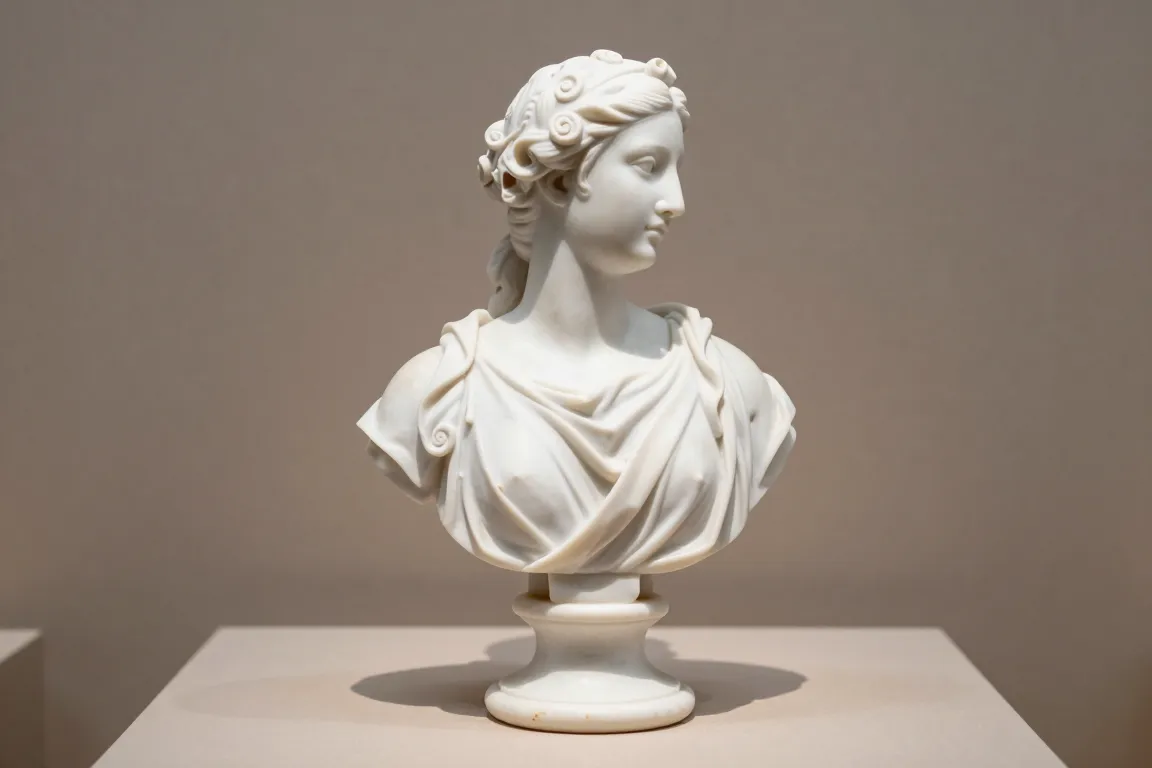
Unglazed white porcelain that copies marble, cast in moulds as statuettes and busts. Victorian potters made it for the home, from copies of known sculpture to sentimental and literary figures.
Core thesis
Fine sculpture comes into the Victorian parlour when a white porcelain slip is cast in a mould and fired without a glaze: marble, but small and cheap.
Design principles
Cast the figure in plaster moulds from a thin, creamy slip of parian paste.
Fire the figure unglazed at about 1200 °C, so that the surface looks like Parian marble.
Take the subject from a known sculpture: a Greek Slave, a Dorothea, a Venus, a bust of a poet or a queen.
Make the figure 20 to 60 cm high, and the bust 20 to 40 cm.
Keep the surface smooth and waxy, with a faint orange-peel grain.
Give detail with sharp relief: curls, laurel, lace and drapery, in shallow depth.
Add a coloured glaze or a little tinted slip only as a ground, never over the flesh.
Mark the base with the maker, the sculptor and the date of the registry.
Anti-patterns
A glossy glaze over the figure
A bright enamel painting on the dress
A rough earthenware body with visible grain
A pose in rococo S-curves with lace dipped in slip