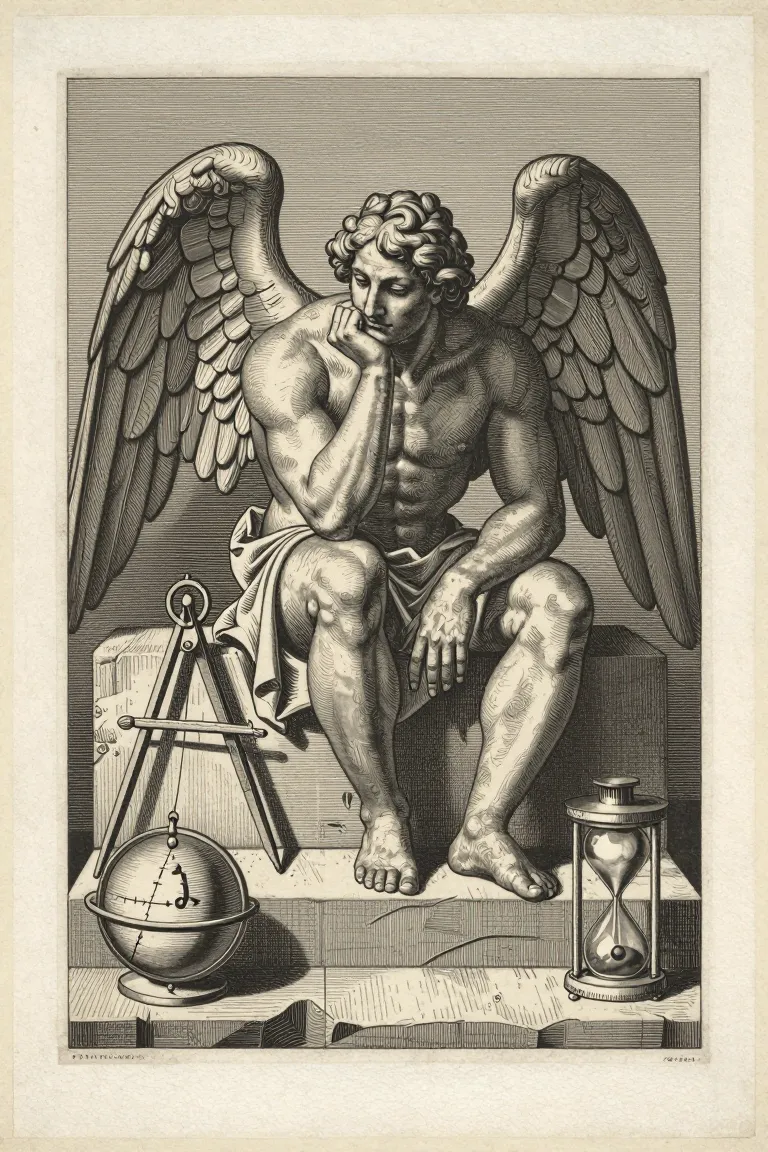
A picture cut into a copper plate with a burin, inked into the grooves and printed under great pressure. Schongauer and Dürer made it an art; Goltzius made the swelling line a show of skill; for three centuries it reproduced paintings and maps.
Core thesis
A burin line that swells and tapers in polished copper gives the finest and most even tone that a hand can make.
Design principles
Build every tone from lines that swell in the middle and taper at both ends.
Lay the lines in systems: parallel lines for a half tone, a second set crossed at 30–45° for the shadow, and dots in the gaps (dot-and-lozenge) for the deepest dark.
Turn each line round the form, like the lines of a contour map, so the swell shows the light.
Keep the line pitch at 80–150 a inch; the eye at reading distance sees a grey, not lines.
Leave a clear plate mark 10–20 mm outside the image, with the title and the names of the designer and the engraver in the margin.
Print in one black or dark brown ink on dampened paper.