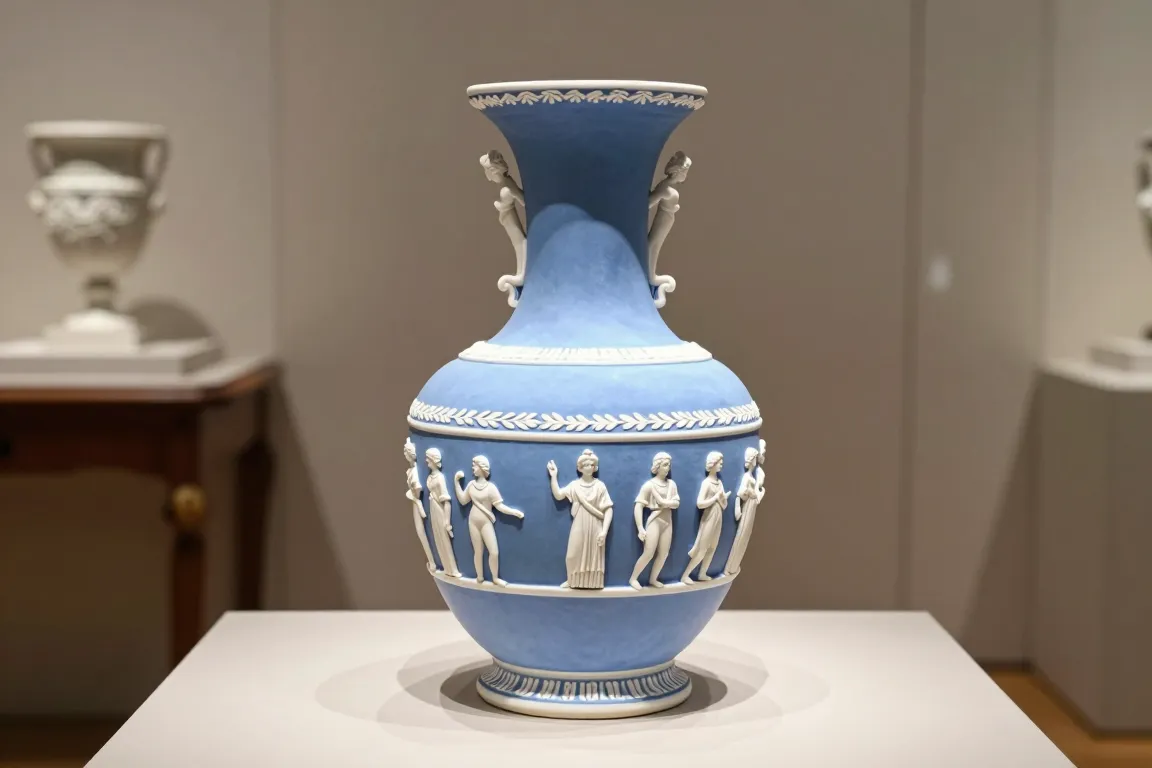
A fine, dense, unglazed stoneware that Josiah Wedgwood made from 1775. It is stained in pale blue, green or lilac and carries white relief figures in the classical manner.
Core thesis
A matt coloured stoneware with white Greek and Roman reliefs lets an English factory make the antique world for the library table.
Design principles
Stain the whole body, not only the surface, with cobalt, so that the blue shows in each chip.
Leave the surface unglazed and fine-polished, so that it has a velvet matt look.
Press each white relief in a pitcher mould, 1 to 3 mm thick, and fix it to the damp body with water.
Take the figures from Greek vases and Roman gems: dancing women, sacrifices, Cupid and muses.
Use the solid jasper for fine pieces and the jasper dip, a thin coloured skin on a white body, for cheaper pieces.
Divide the surface into bands: a laurel or key-pattern border, a main frieze and a plain foot.
Fire the body once to full density at about 1200 to 1250 °C.
Mark the base with the factory name impressed in the clay.
Anti-patterns
A glossy glaze over the relief
Reliefs painted on in colour
A coarse or speckled body
Rococo scrolls and asymmetric forms
Reliefs that are thick and soft, with no sharp edge