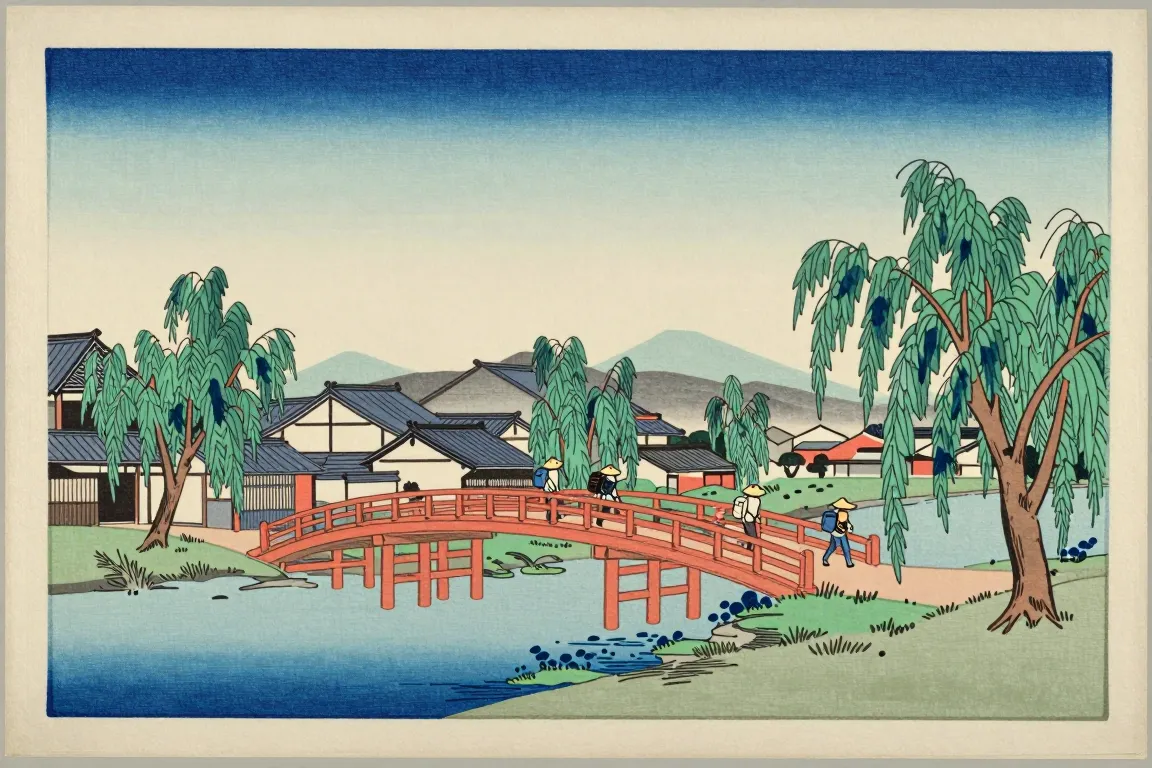
A drawing is pasted on a cherry plank and cut by a carver. A printer rubs water-based pigment from one block for each colour onto damp washi with a baren. The colours are flat and soft, and the wood grain shows.
Core thesis
A set of wood blocks, one for each colour, can make a full-colour picture when a printer rubs thin water-based colour into damp paper and keeps each block in register by hand.
Design principles
Print a sumi key block first. Keep its line 0.2–0.5 mm wide and unbroken, so the carver can follow it.
Give each flat colour its own block. Use 3–12 blocks, and let the inks mix where two colours overlap.
Cut two L-shaped register marks (kento) on each block, so each colour lands on the key line within 0.5 mm.
Make a gradation (bokashi) by wiping the ink on the block with a damp cloth. Place it at the sky, the water and the hem of a robe.
Leave the wood grain in the large flat areas. Do not hide it with extra ink.
Press a bare, inkless block into the sheet (karazuri) where you need a raised line, for example on snow or a collar.
Print on thin damp washi, and rub the back with a baren in a circle until the colour sinks into the fibre.