painting · 1680s–1860s · also: Pictures of the floating world, Edo woodblock print, Nishiki-e
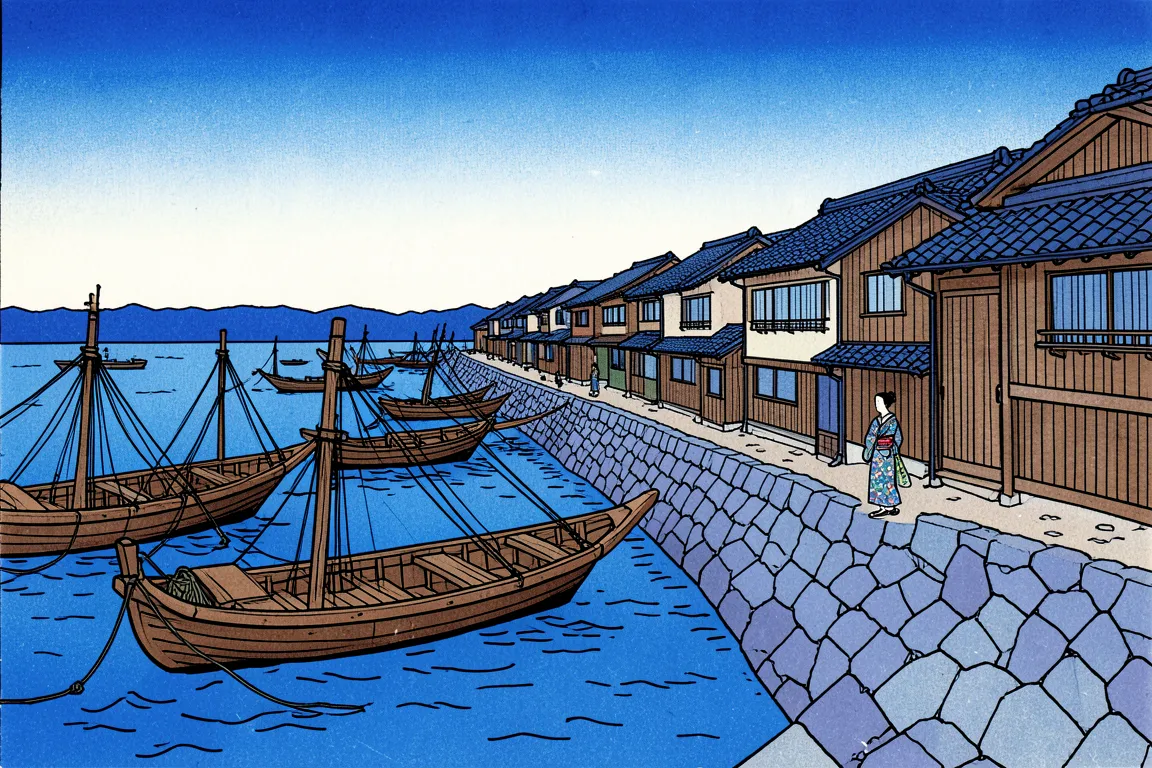
Japanese woodblock prints and paintings of the Edo city: a firm black contour, flat fields of colour, bold cropping and a high or tilted viewpoint. A team of artist, carver and printer makes each sheet, and publishers sell it to a mass market.
Core thesis
A picture is a printed sheet in which the contour, the flat colour and the cropped viewpoint carry everything, and the moment is as fleeting as the city.
Design principles
Draw each form with a clean contour of uniform thickness, 1–2mm on a print of 25cm, and fill it with flat colour.
Set the horizon high, or tilt the ground plane up, so that the picture reads as a layered map and not as a box of space.
Cut figures and objects at the edge on purpose: a close foreground form fills 20–40% of the width.
Print the sky as a gradation (bokashi) from deep colour at the edge to white at the horizon, in a band of 15–25% of the height.
Use 4–8 flat colours and let the paper show as white; shade is a pattern or a line, not a blend.
Put a framed text cartouche, a title block and a signature seal in a corner, as part of the layout.
Fill planes of cloth, water and ground with repeated pattern: waves, rain lines, fabric motifs.
Anti-patterns
Modelled shading with a smooth gradient on figures
Cast shadows and linear perspective with a low horizon
Painterly brush texture or visible canvas
Colour blending that hides the edge between two colour fields