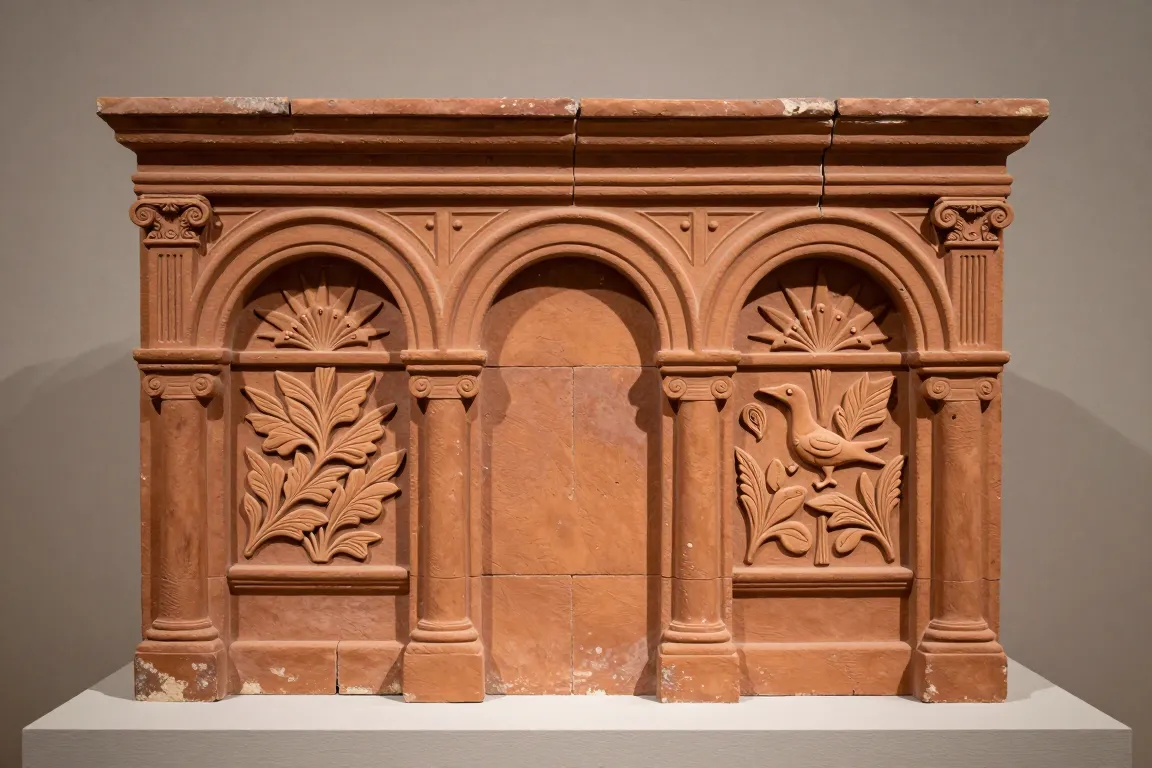
Fired clay blocks in buff, red and blue-grey that English makers pressed in moulds for museums, schools and town halls. Cheap in a smoky city, the clay kept its colour where stone turned black.
Core thesis
A smoky industrial city needs a facade that rain can wash: a glazed or hard-fired clay block gives rich ornament at a price that a mason cannot meet.
Design principles
Press the ornament in plaster moulds, so that one design repeats across a whole facade.
Make each block hollow, with webs inside, 25 to 50 mm thick, so that it dries and fires without a crack.
Use one colour for the main wall and a second for the band, the arch and the frieze.
Model plant and animal forms in high relief: leaves, birds, fruit, beasts and Romanesque arches.
Fire the blocks at a high heat until the clay is hard and does not take soot.
Hang the blocks on a brick or iron frame with iron cramps and fill the cavity with mortar.
Add a glaze or a coloured slip for the bands that need to wash clean in the rain.
Anti-patterns
A smooth cast concrete facade with no moulded ornament
Blocks that vary in colour from one firing to the next
A carved stone detail that a mason cuts one by one