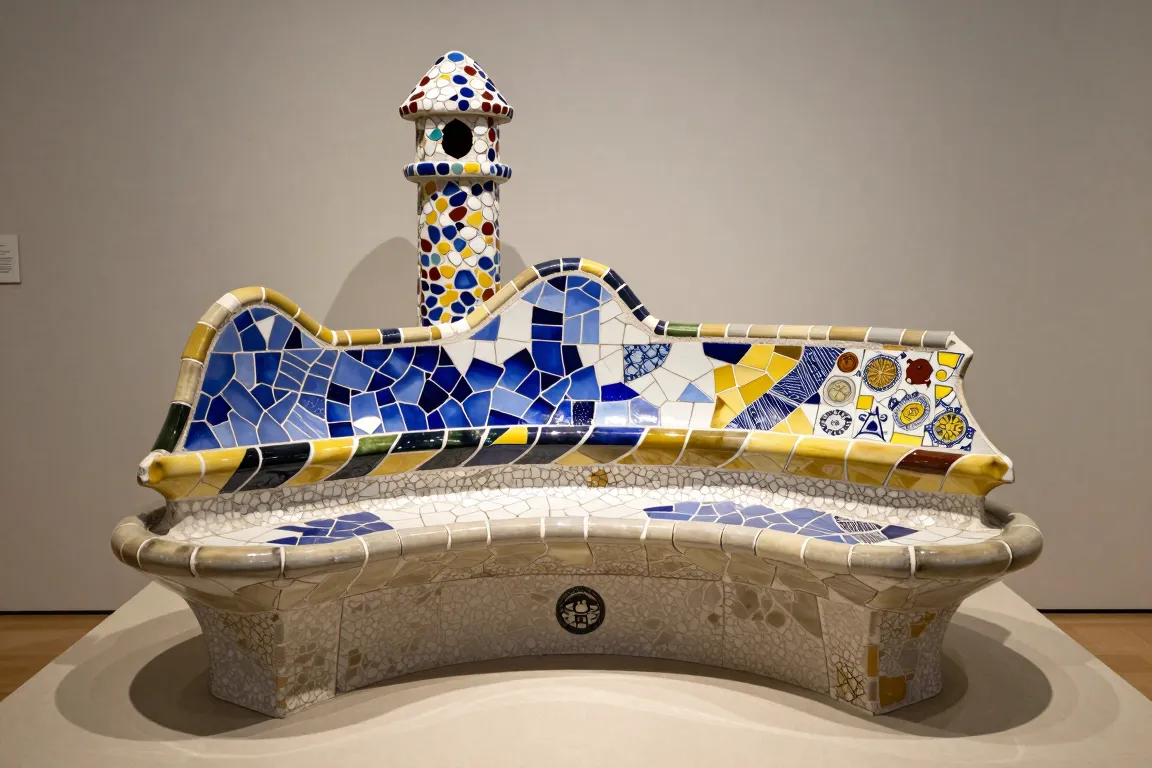
ceramics · 1900 to the present · also: Broken tile mosaic, Pique assiette on architecture, Shard mosaic
A surface of broken tile and china that is set in mortar on a curved wall, bench or roof. Antoni Gaudí and Josep Maria Jujol made it a free, colourful skin for Barcelona buildings.
Core thesis
A broken tile is not waste: a wall of shards takes any curve, and the glaze colour of each piece joins into one bright surface.
Design principles
Break glazed tiles and plates with a hammer into pieces of 2 to 10 cm.
Set the pieces in a bed of wet mortar on a curved wall, a bench or a chimney.
Mix many colours in one field; place the pieces at random and keep the pattern loose.
Add shards of plates, bottle glass and cups, so that a few printed motifs appear.
Keep the glaze face outward; the sharp edges of the shards stay below the grout line.
Fill the gaps with a thin mortar joint of 3 to 5 mm and wipe the face clean.
Use the mosaic on a form that has a curve: a serpentine bench, a lizard, a dome or a chimney.