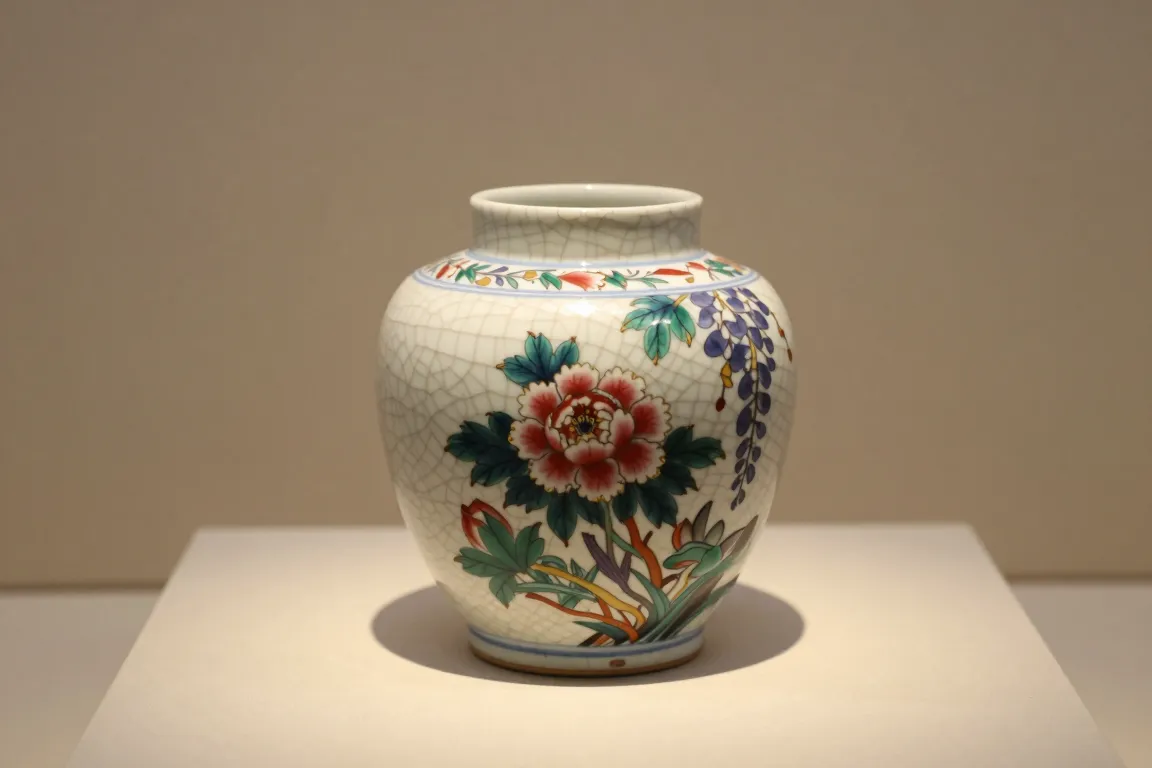
Fine pottery from Kyoto that Nonomura Ninsei made at the kiln of Omuro. A thin crackle glaze takes enamel colours and gold in painted designs of flowers, hills and seasons.
Core thesis
A Kyoto potter can make tea ware as rich as a screen painting: a thin body, a pale crackle glaze, enamel and gold.
Design principles
Throw a thin, smooth form on the wheel, with a wall of 3 to 5 mm.
Cover the form with a pale crackle glaze that is fired first at about 1100 °C.
Paint the design in enamel colours and gold on the fired glaze, and fire again at 800 °C.
Place the design to fit the form: wisteria down a tall jar, peony round a water jar.
Keep part of the glaze plain, so that the painted area has room.
Use the Kyoto court palette: green, blue, red, purple, black and gold.
Sign the base with the maker's seal, as the Omuro kiln did.
Make each piece one of a small set, for a tea master or a temple.
Anti-patterns
A thick rough glaze with fire marks and no overglaze
A single plain colour with no painted design
A print or a transfer pattern in place of the brush