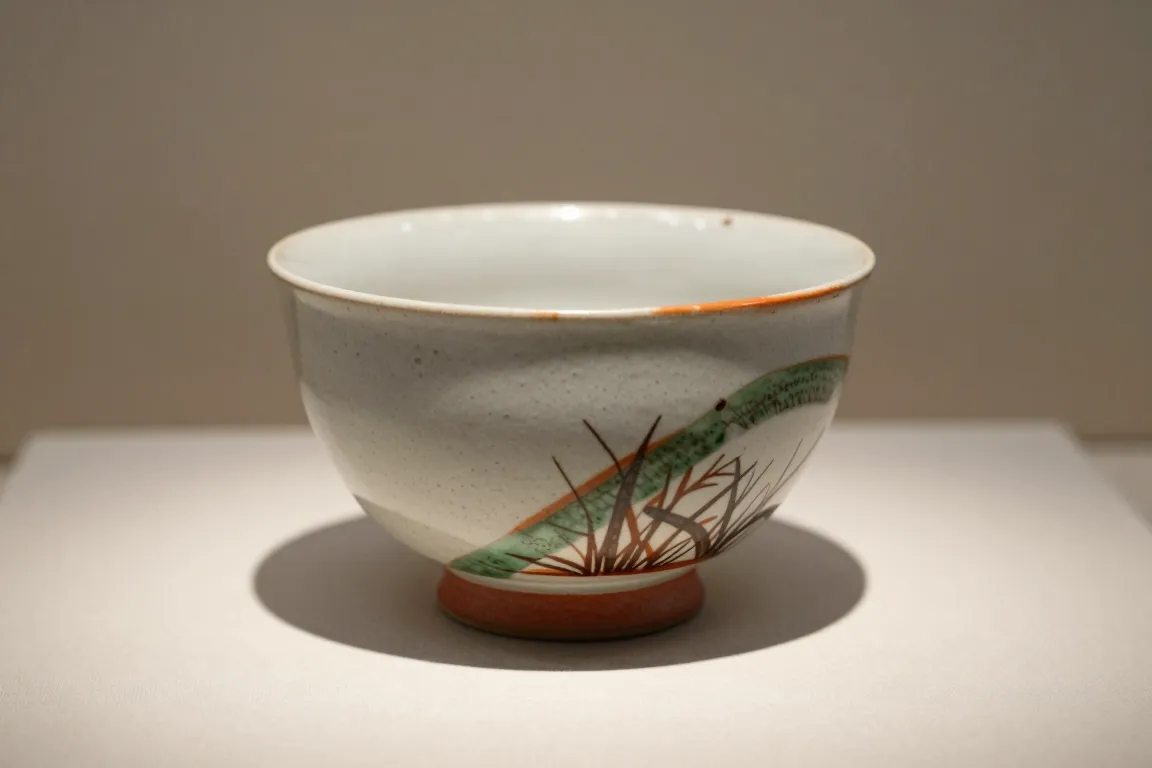
Japanese stoneware for the tea room from the kilns of Mino. The first white Shino glaze, the green Oribe glaze and the black Setoguro glaze go on bold forms with bold painted lines.
Core thesis
Japanese potters of the Momoyama period make their own tea ware: thick glaze, free brush and a form that is bent on purpose.
Design principles
Cover the body with a thick feldspar glaze, 1 to 2 mm, so that the glaze shows pinholes and crawling.
Paint with iron oxide in a few quick strokes: grass, bridges, fences and plain lines.
Bend the form on purpose: press the rim out of round and let one side lean.
Divide the surface: one part glazed in green, one part in white or bare.
Fire in a climbing kiln in reduction at 1200 to 1250 °C.
Leave a fire-orange blush where the white glaze is thin and the clay shows.
Choose one colour in the glaze and one tone in the painting for each piece.
Match each form to a use in the tea room: a bowl, a water jar or a tea jar.
Anti-patterns
A thin even glaze with no pinholes or pooling
A symmetric perfect round form with no lean
A fine printed pattern copied from Chinese porcelain